SYLLABUS
GS-3: Science and Technology- Developments and their Applications and Effects in Everyday Life.
Context: The recent AI Diffusion Report 2025, published by Microsoft’s AI Economy Institute (AIEI) shows trends in AI adoption in India and worldwide, underscoring the need for stronger digital infrastructure, skilling, and inclusive AI strategies.
Key findings of the Report
- Global Findings
- Methodology used:
- Microsoft measures AI diffusion which is defined as “the share of people worldwide who have used a generative AI product during the reported period.”
- This metric is derived from aggregated and anonymised Microsoft telemetry, with suitable adjustments made to reflect differences in OS and device-market share, internet penetration, and population.
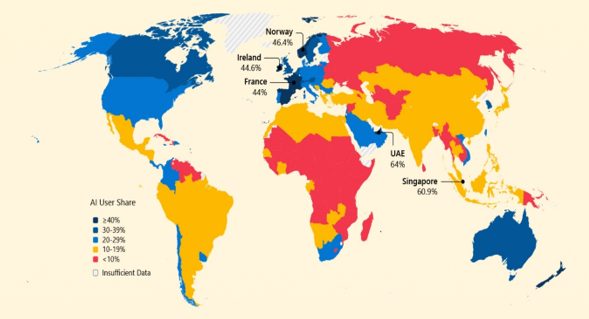
- Global AI adoption: Increased by 1.2 per cent to 16.3 per cent in H2 2025, up from 15.1 percent in the first half of the year — with roughly one in six people worldwide now using generative AI tools.
- AI Race lead: The United Arab Emirates and Singapore continued to top the list of countries with the largest share of people using AI, followed by other small-sized countries such as Norway, Ireland, France, and Spain.
- Methodology used:
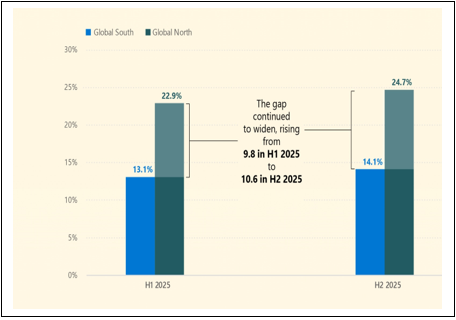
- Widening AI adoption gap: AI adoption in the Global North is growing nearly twice as fast as in the Global South.
- Around 24.7 per cent of the working age population in the Global North is now using these tools, compared to only 14.1 per cent in the Global South, as per the report.
- Investments in AI infrastructure: Countries that have invested early in digital infrastructure, AI skilling, and government adoption, such as the United Arab Emirates, Singapore, Norway, Ireland, France, and Spain, continue to lead.
- Innovation does not guarantee AI adoption: Despite the US leading in terms of AI infrastructure and frontier model development, the country dropped from 23rd to 24th place in AI usage in H2 2025.
- Breakthrough success of DeepSeek: While the Chinese AI startup’s open-weight models have not found popularity in Western countries, they have gained significant traction in markets such as Russia, Iran, Cuba, and Belarus, due to:-
- its open-source approach (by releasing its model under an open-source MIT license)
- accessibility factors
- offering a completely free chatbot
- India-specific findings
- Modest AI usage growth: AI diffusion increased by 1.4 per cent to 15.7 per cent in the second half of 2025, up from 14.2 per cent in the first half.
- Major Market: India has been identified as a key user growth market for AI giants such as OpenAI, Anthropic, Google, and Perplexity.
- Global Ranking: With a population of over 1.45 billion, India currently ranks 64th on the list and continues to trail other large economies such as China, Brazil, Germany, Japan, and the United States.
- High Digital Footprint: India is the second-biggest smartphone market with 730 million devices.
- On average, Indians consume 21 gigabytes of data each month, paying 9.2 cents per gigabyte, one of the world’s lowest mobile data rates.