
SYLLABUS
GS-2: India and its Neighborhood- Relations.
GS-3: Security Challenges and their Management in Border Areas – Linkages of Organized Crime with Terrorism.
Context: India strongly opposed Chinese infrastructure activity in Pakistan-occupied Kashmir’s Shaksgam Valley, reiterating that the strategically sensitive region is Indian territory and warning against any attempts to alter facts on the ground.
More on the News:
• India’s remarks follow reports that China is constructing an all-weather road in the Shaksgam Valley, located north of the Siachen Glacier and close to areas of major strategic importance for Indian forces.
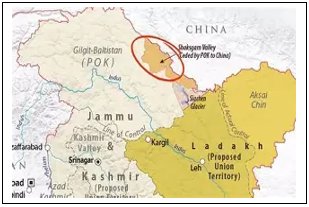
- According to reports, nearly 75 kilometres of the road, estimated to be around 10 metres wide, has already been completed by China, with construction continuing at a rapid pace.
• Beijing’s construction activity in Shaksgam has gained pace after the 2017 standoff in Bhutan’s Doklam.
MEA (Ministry of External Affairs) Response:
• India has officially opposed Chinese infrastructure construction in the Shaksgam Valley, describing the region as Indian territory.
• The MEA also said that India does not recognise the China–Pakistan Economic Corridor (CPEC), a flagship Belt and Road Initiative project, as it passes through Indian territory under Pakistan’s “forcible and illegal occupation.”
• India reiterated that the entire Union Territories of Jammu & Kashmir and Ladakh are an integral and inalienable part of India, and this was clearly conveyed to Pakistani and Chinese authorities.
• India “reserves the right to take necessary measures to safeguard our interests,” signalling continued diplomatic and strategic vigilance over developments in the region.
About Shaksgam Valley:
• Shaksgam Valley is a 5,180 sq km Indian territory that lies between the Karakoram Range and the Kunlun Mountains, and is located north of the Siachen Glacier area.
• It was illegally occupied by Pakistan during the 1947 invasion of Jammu and Kashmir and in 1963 with the “Boundary Agreement” signed between China and Pakistan, Pakistan illegally ceded it to China.
- The Agreement provided a common boundary for Pakistan and China, which otherwise would have had no borders.
- The Agreement also has a clause that stipulates that after the settlement of Kashmir dispute between Pakistan and India, the sovereign authority will reopen negotiations with the government of China to sign a formal boundary treaty.
- India has never recognized the Agreement, arguing Pakistan had no legal right to transfer the territory.
Major Disputed Territories with China
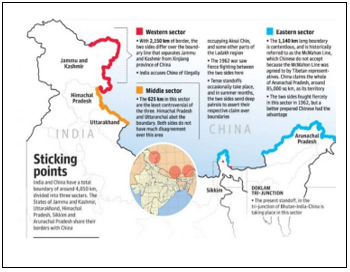
• Aksai Chin (Eastern Ladakh): Indian territory, controlled by China, and connects Tibet with Xinjiang via G219 highway.
• Eastern Ladakh zone: regular military standoffs in Depsang Plains, Demchok, Pangong Tso etc. due to unclear Line of Actual Control (LAC).
• Barahoti (Chamoli district, Uttarakhand): China claims the pasture as its territory, and PLA (People’s Liberation Army) patrols frequently enter the area, damage huts, or intimidate locals.
• Arunachal Pradesh: China claims it as “South Tibet” and frequently engages in “standardised names” for its locations to reinforce claims.