
SYLLABUS
GS-2: Government Policies and Interventions for Development in various sectors and Issues arising out of their Design and Implementation.
GS-3: Conservation, Environmental Pollution and Degradation.
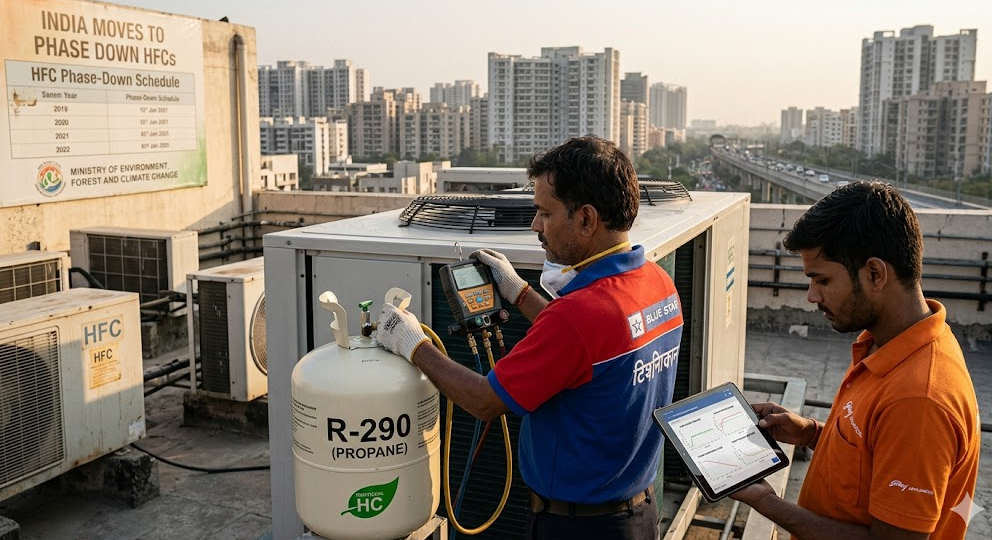
Context: India has announced a major regulatory step to restrict new production capacity of Hydrofluorocarbons (HFCs) after 2027, signalling a transition towards climate-friendly cooling systems.
More on the News
- The Government has directed all state and Central authorities to stop granting environmental clearances for new or additional HFC production beyond December 31, 2027.
- From January 1, 2028, India will freeze HFC consumption and production at baseline levels, marking the beginning of the phase-down trajectory.
- The policy is expected to be implemented through amendments to the Ozone Depleting Substances (Regulation and Control) Rules, extending regulatory control to HFCs.
- The direction is in line with India’s commitments under the Kigali Amendment to phase down HFCs, potent greenhouse gases used in refrigeration and air conditioning.
About HFCs (Hydrofluorocarbons)
- HFCs are synthetic refrigerant gases widely used in air conditioning, refrigeration, aerosols, and fire suppression systems.
- They were introduced as alternatives to ozone-depleting substances CFCs and HCFCs, which were phased out under the landmark Montreal Protocol of 1989.
- While they have zero ozone‑depletion potential (ODP), they have extremely high global warming potential (GWP)—up to 14,800 times that of CO₂ over 100 years—making them a major driver of climate change.
- HFCs account for 2% of total GHG emissions globally, but their increasing use in developing economies has made them a key target for climate mitigation efforts.
About the Montreal Protocol and Kigali Amendment
- The Montreal Protocol (1987) is a landmark global treaty aimed at phasing out ozone-depleting substances, widely regarded as one of the most successful environmental agreements.
- The Kigali Amendment (2016) extended the protocol to include phasing down HFCs, recognising their high climate impact.
- India ratified the Kigali Amendment in2021, committing to a gradual reduction in HFC production and consumption.
- India has agreed to a phase-down schedule from January 1, 2028, onwards, which will see 10 per cent reduction in HFCs by 2032, rising up to 85 per cent by 2047.
- Globally, the amendment is expected to avoid up to 0.5°C of global warming by 2100, making it a critical climate mitigation instrument.
India’s Roadmap to Phase Out HFCs
- Reduction Targets:
- 10% reduction by 2032
- 20% reduction by 2037
- 30% reduction by 2042
- 85% reduction by 2047
- Baseline Years: 2024–2026 for calculating HFC consumption and production levels.
- Freeze Year: 2028 (consumption and production capped at baseline levels).