
SYLLABUS
GS-2: Government Policies and Interventions for Development in various sectors and Issues arising out of their Design and Implementation.
GS-3: Conservation, Environmental Pollution and Degradation, Environmental Impact Assessment.
Context: India plans to unlock 100 gigawatts (GW) of hydro pumped storage capacity over the next two decades as it races to stabilise a power system increasingly dominated by solar and wind, according to a roadmap prepared by the Central Electricity Authority (CEA).
More on the news
• The “Roadmap to 100 GW of Hydro Pumped Storage Projects by 2035-36” report prepared by CEA was released at a two-day Chintan Shivir organised by the Ministry of Power at Parwanoo, Himachal Pradesh.
• The 14th Integrated Rating and Ranking Report of power distribution utilities was also released at the Chintan Shivir.
- Torrent Power Ahmadabad and Torrent Power Surat have topped the ratings for FY2024-25.
- Uttar Gujarat Vij Company Ltd (UGVCL) has achieved the Best Ratings among state-owned discoms.
• Deliberations during the two-day Shivir focused on the draft Electricity Amendment Bill, 2026, to ensure financial viability, economic competitiveness, and energy transition, as well as the Draft Electricity Policy, 2026, to meet the vision of Viksit Bharat 2047.
Key Highlights of the Report
• India’s strategy to address rising energy storage demands: driven by an increase in non-fossil fuel capacity to 500 GW by 2030 and 701 GW by 2035.
• Target Capacity
- Short-term: 62 GW of total energy storage requirement by 2029-30.
- Medium-term: 161 GW by 2034-35, driven by rising renewable penetration.
- Long-term: commissioning 100 GW of PSPs by 2035-36.
• Site Potential: Over 120 potential pumped storage sites have been identified with total potential exceeding 180 GW, offering flexibility for phased development.
• Current Progress: Around 22 GW of pumped storage projects are already at various stages of development, with another 50-60 GW shortlisted for rollout by 2032-37.
• Investment Needs: Cumulative investments are estimated at ₹5-6 lakh crore (roughly $77 billion) to build the targeted 100 GW capacity, with public-private partnerships and market-based procurement expected to improve financing and project bankability.
• Early Anchors: States such as Andhra Pradesh, Maharashtra, Odisha, Gujarat, and Tamil Nadu are set to be early anchors of pumped storage expansion, using existing reservoirs and closed-loop systems to reduce social and environmental impacts.
About Pumped Storage Projects (PSPs)
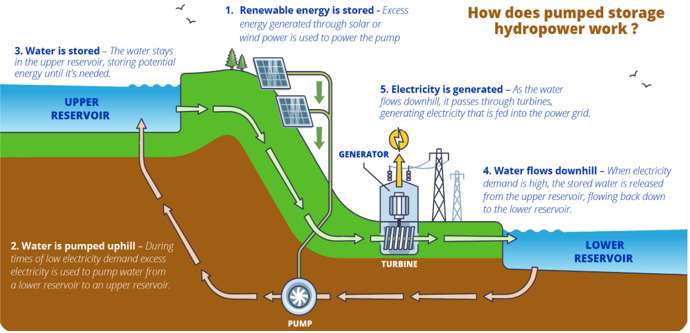
• Definition: Pumped Storage Projects, also called as Pumped Hydro Storage (PHS), are large-scale energy storage systems that use the gravitational potential of water to store and generate electricity.
• Types of PSPs:
- On-stream pumped storage scheme: Both reservoirs are located on any river/ stream/ nallah.
- Off-stream open loop pumped storage scheme: One reservoir is located on a river/ stream/ nallah, and the other reservoir (off-stream reservoir) is not located on any river/ perennial stream/ perennial nallah.
- Off-stream closed loop pumped storage scheme: None of the reservoirs is located on any river/ perennial stream/ perennial nallah.
• Need and Advantages of Pumped Storage Projects:
- Integration with other renewable sources: Essential for ensuring the smooth integration of the rapidly growing share of renewable energy sources— particularly variable and intermittent solar and wind—into the national grid, alongside emerging technologies such as Electric Vehicles (EVs).
- Longer and more reliable duration of storage:
- Globally, PSPs account for over 95% of installed energy storage capacity, storing nearly 9,000 GWh of electricity, underscoring their proven effectiveness as large-scale storage solutions.
- Capable of providing gigawatt-scale storage with long duration discharge of up to about eight hours a day, and offer operational flexibility through frequent start–stop operations and fast ramping capabilities.
- With a long life cycle of around 100 years (with periodic R&M of electro-mechanical systems), PSPs remain a durable and sustainable asset.
- Eco-friendly: Being a clean and green technology with high domestic content, they contribute to Atmanirbharta in the energy sector.
Significance of the Report
• The roadmap underscores how India’s Clean Energy Investment Drive at Davos is designed to bridge the gap between variable renewable generation and dependable electricity supply, a key step toward energy security, cost efficiency, and climate goals.
• The strategy positions pumped storage as the backbone of grid-scale energy storage, critical for managing peak demand, ensuring round-the-clock power supply and supporting the country’s Net Zero transition.
• The report supports Clean Energy Goals as India aims for 500 GW non-fossil fuel capacity by 2030 and reduce reliance on fossil fuels.