SYLLABUS
GS-2: Bilateral, regional and global groupings and agreements involving India and/or affecting India’s interests.
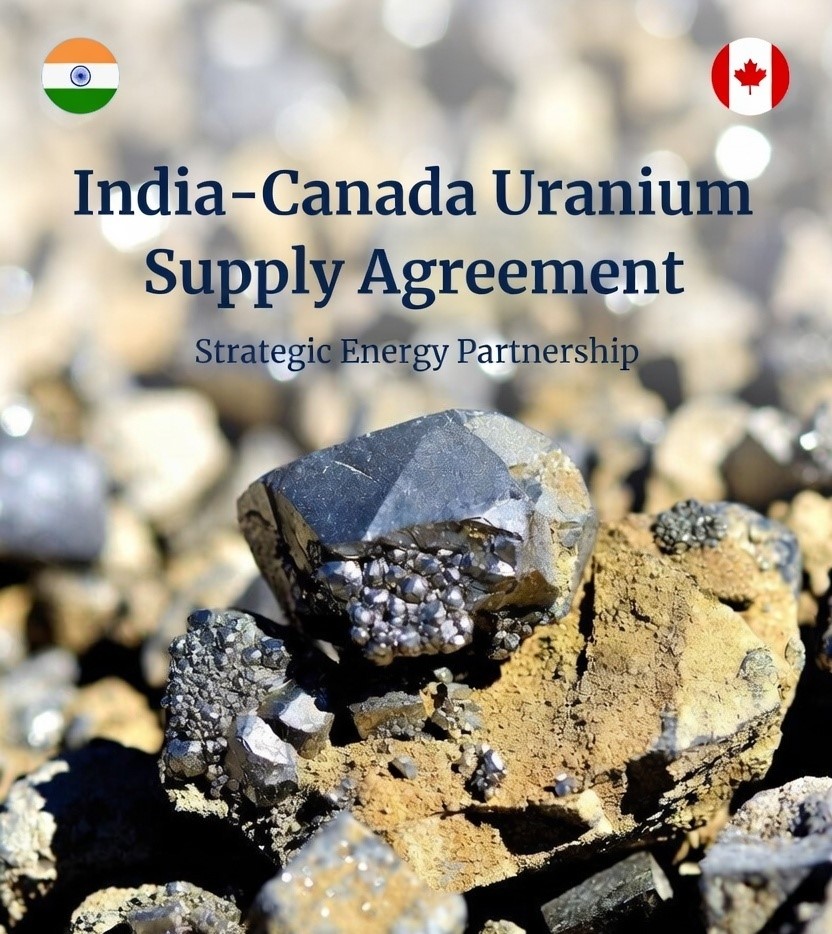
Context: Recently, India and Canada signed a long-term uranium supply agreement to fuel India’s civil nuclear power reactors.
More on the News
- The deal establishes a long-term supply of uranium from Canada to support India’s civil nuclear energy programme.
- The contract was signed between India’s Department of Atomic Energy and Canadian nuclear company Cameco.
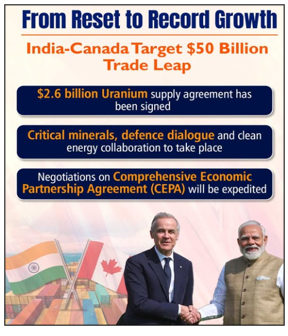
- The agreement is valued at about 2.6 billion Canadian dollars and involves the supply of about 10,000 tonnes of uranium between 2027 and 2035.
- Both countries also agreed to expand collaboration in advanced nuclear technologies, including small modular reactors and next-generation nuclear reactors.
- Incidentally, this is India’s second major uranium supply deal within a month. Two weeks ago, it was revealed that India had finalised a similar agreement with Kazakhstan’s state-owned company Kazatomprom.
- Additionally, both countries also expressed the aim to increase bilateral trade to around 50 billion dollars by 2030.
Significance of the Deal
- Strengthening Energy Security: The long-term uranium supply ensures reliable nuclear fuel availability, reducing risks of fuel shortages and supporting uninterrupted operation of India’s expanding nuclear reactor fleet.
- Supporting Clean Energy Transition: By securing uranium supplies, the agreement reinforces nuclear power’s role as a low-carbon baseload energy source, helping India diversify its energy mix and progress toward climate and net-zero commitments.
- Boost to Nuclear Power Expansion: Stable fuel access enables India to scale up nuclear generation capacity to meet rising electricity demand, particularly as the country targets significant growth in nuclear power in the coming decades.
- Strategic and Technological Cooperation: The partnership strengthens India–Canada relations while opening avenues for collaboration in advanced nuclear technologies such as Small Modular Reactors (SMRs) and next-generation reactor systems.
Uranium Landscape of India
- India possesses relatively modest uranium reserves with low ore grades (generally around 0.02–0.45%, compared to the global average of about 1–2%), making domestic extraction more expensive and less productive.
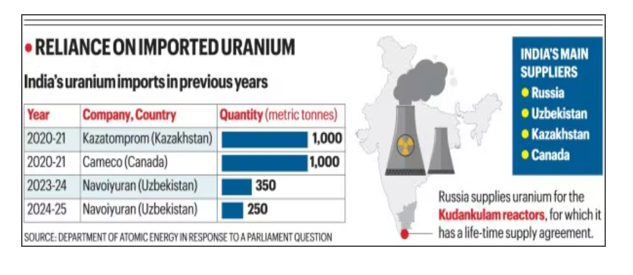
- Due to limited domestic production capacity, over 70% of India’s uranium requirements are met through imports, mainly from countries such as Canada, Kazakhstan, Uzbekistan and Russia.
- India currently requires roughly 1,500–2,000 tonnes of uranium annually, and this demand is expected to increase significantly as the country expands its nuclear power capacity.
- Domestic uranium deposits are primarily located in Jharkhand and Andhra Pradesh, with additional reserves identified in Rajasthan, Telangana and Meghalaya.
- Uranium forms the first stage of India’s three-stage nuclear power programme, which ultimately aims to utilise the country’s vast thorium reserves for long-term energy security.
- India currently operates about 25 nuclear reactors with a capacity of about 9 GW. It aims to expand nuclear power capacity to 100 GW by 2047 under the recently launched Nuclear Energy Mission.