
SYLLABUS
GS-2: Important International institutions, agencies and fora- their structure, mandate.
GS-3: Achievements of Indians in science & technology; indigenization of technology and developing new technology
Context: The India–AI Impact Summit 2026 concluded with the adoption of the New Delhi Declaration on AI Impact, marking the first global AI summit in the Global South and signaling a shift in global AI governance toward inclusivity and real-world impact.
More on the News
- Held at Bharat Mandapam, New Delhi, from 16–21 February 2026, the summit was organised under the IndiaAI Mission by the Ministry of Electronics and IT (MeitY).
- It was announced by Prime Minister Narendra Modi at the France AI Action Summit 2025.
- It is the fourth summit in the global AI summit series (after UK 2023, Seoul 2024, Paris 2025).
- The summit focused on practical deployment and global impact of AI, moving beyond earlier safety-centric dialogues.
Objectives of the India-Hosted Summit
- Promote the vision of “AI for All” and expand access to AI capabilities globally.
- Ensure AI relevance for the Global South, including multilingual AI and inclusive datasets.
- Position India as a global AI infrastructure and innovation hub.
- Encourage investments and partnerships across sectors such as healthcare, agriculture, and education.
- Build global consensus around safe, trusted, and inclusive AI.
About the New Delhi Declaration on AI Impact (2026)
- The New Delhi Declaration on AI Impact, adopted at the India AI Impact Summit 2026, marks a major milestone in global cooperation on artificial intelligence.
- Endorsed by 89 countries and international organisations, it reflects a broad global consensus on leveraging AI for economic growth and social good.
- Guided by the civilisational principle of “Sarvajan Hitaya, Sarvajan Sukhaya” (Welfare for all, Happiness for all), the declaration emphasises equitable access to AI benefits and inclusive global development.
- The declaration outlines a cooperative and multilateral vision for AI governance, emphasising:
- Strengthened international cooperation and multistakeholder engagement
- Respect for national sovereignty in AI governance
- Development of accessible, trustworthy, and inclusive AI frameworks
- Promotion of open and interoperable AI ecosystems
- Emphasis on energy-efficient and sustainable AI infrastructure
- Expanding AI applications across science, governance, and public service delivery
- Participants reaffirmed their commitment to advancing shared global priorities through voluntary and non-binding cooperation frameworks, encouraging wider participation and trust-building.
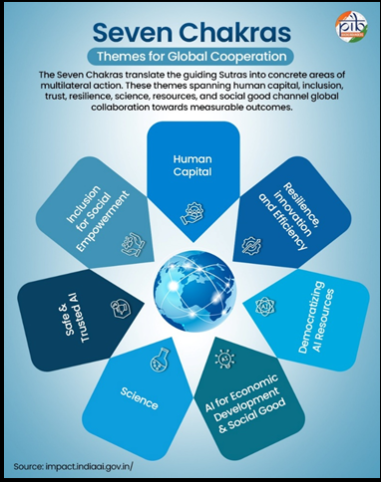
- Seven Pillars (Chakras) of Action: The declaration is structured around seven thematic pillars that guide global collaboration and implementation across sectors.
- These pillars collectively translate the vision of inclusive AI into actionable areas of cooperation.
- To operationalise its vision, the declaration proposes several collaborative international initiatives:
- Democratic Diffusion of AI Charter: Promotes equitable global access to AI technologies.
- Global AI Impact Commons: A shared repository of AI use cases and best practices.
- Trusted AI Commons: Tools, benchmarks, and frameworks for secure and trustworthy AI systems.
- International Network of AI for Science Institutions: Linking global research and technical institutions.
- AI for Social Empowerment Platform: Advancing inclusive and socially beneficial AI deployments.
- AI Workforce Development Playbook and Reskilling Principles: Framework for skilling and workforce transition.
- Guiding Principles on Resilient and Efficient AI: Focused on sustainability and system robustness.
Key Takeaways of the Summit 2026
- Human-Centric AI Vision – M.A.N.A.V. Framework; Prime Minister Narendra Modi articulated the M.A.N.A.V. vision, positioning India as a champion of ethical and inclusive AI.
- M – Moral & Ethical Systems: Fairness, transparency, and human oversight in AI development.
- A – Accountable Governance: Transparent regulatory frameworks and institutional responsibility.
- N – National Sovereignty: Data security, digital sovereignty, and technological self-reliance.
- A – Accessible & Inclusive AI: Democratisation of AI for public good and Global South inclusion.
- V – Valid & Legitimate Systems: Trustworthy, lawful, and verifiable AI deployment.
- Massive Investments and Ecosystem Expansion:
- The summit showcased large-scale public and private commitments to rapidly scale India’s AI ecosystem, including nearly $250 billion in investment pledges, with $20 billion earmarked for deep-tech research.
- It marked the launch of indigenous AI models such as Sarvam AI’s 30B and 105B parameter Mixture-of-Experts LLMs, along with speech and vision AI tools and innovations like Kaze smart glasses.
- BharatGen introduced Param2 (17B parameters), a multimodal model supporting 22 Indian languages, highlighting India’s multilingual AI capabilities.
- AI infrastructure expansion followed a “whole-of-nation” strategy focused on frugal, sovereign, and scalable AI, including the addition of 20,000+ GPUs to an existing ~38,000 base.
- Strengthening partnerships between Indian and global AI firms; Microsoft announced a $50 billion investment by 2030 to expand AI in developing countries.
- India joined initiatives such as Pax Silica to diversify technology supply chains.
- India set a Guinness World Record for the largest AI responsibility pledge campaign, with 250,946 pledges in 24 hours under the IndiaAI Mission in partnership with Intel India.
About the India–AI Impact Summit 2026
- The India–AI Impact Summit 2026, announced by Prime Minister Narendra Modi at the France AI Action Summit, was held in February 2026, in New Delhi, marking the first global AI summit hosted in the Global South.
- Building on earlier forums such as the UK AI Safety Summit, AI Seoul Summit, France AI Action Summit, and Global AI Summit on Africa, the event marked a shift from high-level discussions to actionable global cooperation on AI.
- The summit aimed to ensure that AI serves humanity through inclusive growth, social development, and people-centric innovation, while amplifying the voice of the Global South.
- It also acknowledged key challenges such as job disruption, bias, and rising energy consumption, highlighting the need for measurable and responsible AI deployment.
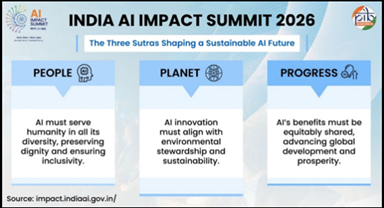
- Three Sutras: The summit was anchored on three guiding pillars:
- Seven Chakras: To operationalise these principles, the summit identified seven areas of cooperation:
- Human Capital; Inclusion for Social Empowerment; Safe and Trusted AI; Resilience, Innovation and Efficiency; Science; Democratizing AI Resources; and AI for Economic Growth and Social Good.
- Together, the Three Sutras and Seven Chakras provide a structured framework for global collaboration to maximise AI’s benefits while addressing shared challenges.