

- The proposed system aims to move Delhi’s pollution control strategy away from blanket bans and emergency responses towards evidence-based, source-specific action.
More on the News:
- Key Features of AI Enabled DSS:
- A key pillar of this approach is “dynamic source apportionment, which will scientifically identify contributions from dust, transport, industry, biomass burning and regional factors”.
- “This data driven method will allow action at the pollution source rather than resorting to bans and reactive measures.
- It aims to strengthen the ability of the Capital to identify pollution sources at a granular level, assess their impact, and enable targeted, timely interventions across sectors.
- Current System and Its Limitations: At present, the Capital relies on Indian Institute of Tropical Meteorology Pune’s (IITM) DSS, however experts have flagged concerns in the past about the reliability of data.
- According to a study by the public policy think tank Council on Energy, Environment, and Water (CEEW) Delhi’s Air Quality Early Warning System (AQEWS) has been able to forecast high-pollution days with more than 80% accuracy, but its reliance on outdated emission inventories and the tendency to underpredict pollutant levels limit its effectiveness.
- Air Quality Early Warning System (AQEWS): It was launched by the Union Ministry of Earth Sciences in 2018 to forecast Delhi’s air quality three days in advance.
- It is run by the Indian Institute of Tropical Meteorology (IITM), Pune, and the India Meteorological Department (IMD).
- In 2021, a Decision Support System (DSS) that tracks sectoral and regional contributions to PM2.5 pollution, was integrated into the system.
- According to the study, AQEWS continues to have a limited ability to detect the most severe air pollution episodes, despite some improvement over the past year.
- The AQEWS accurately predicted only 1 of 15 air pollution episodes with an AQI above 400 in 2023–24, which improved to 5 of 14 such episodes in 2024–25, indicating persistent gaps in the Decision Support System (DSS).
- Ongoing mitigation measures: The Delhi government is acting simultaneously on four key fronts-vehicular emissions, dust control, polluting industries, and waste management with round-the-clock interventions by civic agencies.
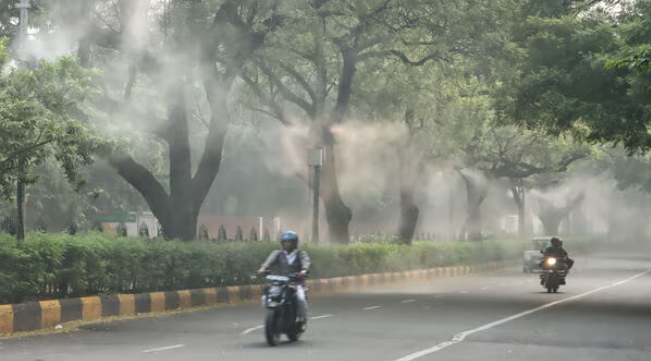
- Strict dust norms at construction sites, mechanical road sweeping, anti-smog guns, and mist spray systems on electric poles are tackling airborne particles effectively.