
SYLLABUS
GS-2: Structure, organisation and functioning of the Executive and the Judiciary—Ministries and Departments of the Government; pressure groups and formal/informal associations and their role in the Polity.
Context: The Election Commission of India’s (ECI) International Conference on Democracy and Election Management (IICDEM) 2026 concluded with the adoption of the Delhi Declaration 2026 at the Bharat Mandapam, New Delhi.
More on the news:
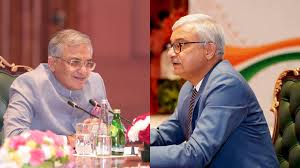
- The conference was chaired by the Chief Election Commissioner (CEC) of India along with the Election Commissioners.
- Heads of 42 Election Management Bodies and experts from more than 70 national institutions participated.
- The Delhi Declaration 2026 was unanimously adopted by all participating Election Management Bodies (EMBs).
- The participants also resolved to review their progress periodically and proposed to meet on the 3rd, 4th and 5th of December 2026 at IIIDEM, New Delhi.
Key Highlights of Delhi Declaration 2026
The Five Pillars of the Delhi Declaration 2026 are as follows:
Pillar I: Purity of Electoral Rolls
- Pure Electoral Rolls, containing names of all eligible electors as per law, are the foundation of any democracy.
- The Election Management Bodies (EMBs) should strive to provide Photo Identity Cards to all electors, for easy and transparent conduct of elections.
Pillar II: Conduct of Elections
- Elections have to be participative and inclusive & involve all stakeholders at all levels.
- For the conduct of elections to be transparent, efficient, free and fair, it is inevitable for the EMBs to function as per the mandate laid down in their Constitution or in their respective laws.
Pillar III: Research and Publications
- The Conference resolved to bring out the Encyclopaedia of Democracies of the World, which shall comprise an Atlas – a comprehensive compilation on how the electoral systems work in different countries and as approved by the respective EMBs.
- Elaborative Reports on the 7 Themes led by International IDEA.
- Reports on 36 Themes led by the India International Institute of Democracy & Election Management (IIIDEM) to be prepared comprehensively.
Pillar IV: Use of Technology
- EMBs would try and adopt latest technologies while ensuring the integrity of elections, as mandated by law, to facilitate the electors and proactively counter misinformation.
- Considering the request of EMBs, India is willing to share its experience of the digital platform ECINET, for co-development of a similar platform for any other EMB in accordance with their laws and in their language.
Pillar V: Training and Capacity Building
- Considering the interest shown by EMBs, India is willing to share its vast experience in the field of elections in all sectors, through training and exchange of its transparent practices.
- Further considering the interest shown by the EMBs, IIIDEM, the world’s largest training institute for election & democracy, which has an experience of training more than 10,000 election staff from India and personnel from more than 100 countries since the past 15 years, is willing to offer its training facilities to all EMBs, to the best of its capabilities, to impart professionalism in the conduct of elections and preparation of Electoral Rolls.
About Election Commission of India
- The Election Commission is a constitutional body established in 1950 by the Constitution of India.
- Originally, the commission had only a Chief Election Commissioner. It currently consists of a Chief Election Commissioner and two Election Commissioners.
- The President appoints the Chief Election Commissioner and Election Commissioners.
- They have tenure of six years, or up to the age of 65 years, whichever is earlier.
Source:
PIB
Punjab news line
The hindu