

SYLLABUS
GS-3: Achievements of Indians in science & technology; indigenization of technology and developing new technology; Awareness in the fields of IT, Space, Computers, robotics, Nano-technology, bio-technology and issues relating to intellectual property rights.
Context: Recently, DRDO carried out the first successful high-speed rocket-sledge testing of an ejection seat for a fighter jet using its proprietary Rail Track Rocket Sledge (RTRS) facility located at the Terminal Ballistics Research Laboratory in Chandigarh.
More on the News
- The test was undertaken with the Aeronautical Development Agency (ADA) and Hindustan Aeronautics Limited (HAL).
- This DRDO test was focused on:
- Canopy Severance System (CSS) – Cutting/blowing off the cockpit canopy
- Ejection sequencing – The entire chain of triggers
- Pilot recovery systems – Parachutes, survival kit, stabilization
- This complex dynamic test places India in an elite club of nations with advanced in-house escape system testing capability.
- Dynamic ejection tests are significantly more complex than static tests such as the Net test or Zero-Zero test and real measure for evaluating ejection seat performance & efficacy of canopy severance system.
How the Test Was Performed
- The test used a Dual Sledge System that was mounted on the nose section of the Light Combat Aircraft (LCA) to replicate real operational conditions.
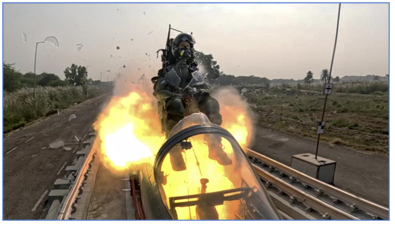
- The Dual Sledge System was fired at a precisely controlled velocity through the sequential ignition of multiple solid-propellant rocket motors to simulate the ejection environment.
- An Instrumented Anthropomorphic Test Dummy, designed to mimic human physiology, was placed in the system to recreate the complete ejection and recovery sequence.
- All key parameters such as load, moment, and acceleration during the ejection event were accurately recorded using onboard measurement systems.
- Ground-based imaging systems were used to capture the entire sequence and validate the behaviour of the dummy and the ejection process.
Significance of the Test
- The successful high-speed rocket-sled test strengthens India’s indigenous capability to design, evaluate, and certify fighter aircraft escape systems, reducing dependence on foreign technologies.
- The validated canopy severance, ejection sequencing, and aircrew recovery processes enhance pilot safety and operational reliability for the Light Combat Aircraft and future indigenous fighter platforms.
- The achievement places India in an elite club of nations with advanced in-house escape system testing capability, marking a major step toward long-term self-reliance in critical aerospace safety technologies.