

SYLABUS
GS 2: Indian Constitution- historical underpinnings, evolution, features, amendments, significant provisions and basic structure; Government policies and interventions for development in various sectors and issues arising out of their design and implementation.
Context: Recently, the Gujarat Assembly passed the Uniform Civil Code (UCC) Bill, becoming the second state after Uttarakhand to adopt the UCC.
Key Provisions of Gujarat UCC
- Mandatory Registration of Marriages:
- The Bill requires compulsory registration of all marriages within 60 days across all religions, with a penalty of up to ₹10,000 for non-compliance.
- It also provides punishment of up to seven years for forced, fraudulent, or multiple marriages.
- Uniform Divorce Framework:
- It introduces a uniform divorce system where court approval and registration are compulsory.
- Out-of-court divorces are not valid and may lead to up to three years’ imprisonment.
- It also gives women the unrestricted right to remarry.
- Equal Inheritance Rights: The Bill guarantees equal succession and inheritance rights for sons and daughters across all religions, aiming to strengthen gender equality and women’s financial security.
- Regulation of Live-in Relationships: Live-in relationships must be compulsorily registered, with non-registration attracting up to three months’ imprisonment or a ₹10,000 fine. Authorities will inform parents if partners are aged between 18 and 21 years.
- Legal Safeguards:
- The Bill provisions do not apply to members of Scheduled Tribes (ST) and certain groups whose customary rights are protected under the Constitution.
- The Bill provides maintenance rights to women and legal recognition to children born from live-in relationships.
- It also prescribes strict penalties in cases involving coercion, fraud, or minors under child protection laws.
About Uniform Civil Code (UCC)
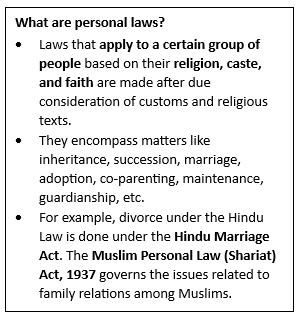
- The UCC is defined as a common set of civil laws that replaces personal laws based on religious customs and traditions, and applies uniformly to all citizens.
- It establishes one law for all individuals in matters such as marriage, divorce, inheritance, and adoption, irrespective of religion.
- It is widely regarded as a measure to promote a more secular and equitable social order, in line with the core ideals of the Indian Constitution.
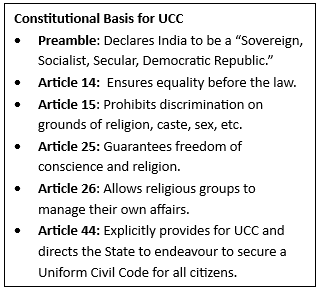
- Article 44 of the Indian Constitution provides for a Uniform Civil Code, which is a part of the Directive Principles of State Policy (DPSP), establishing a uniform set of civil laws applicable to all citizens across the country.
Objectives of the Uniform Civil Code (UCC)
- Equality Before Law: Ensures equal treatment of all citizens, irrespective of religion, by providing a common set of civil laws.
- Gender Justice: Seeks to eliminate discriminatory practices in personal laws, thereby promoting equal rights for women in matters like marriage, divorce, and inheritance.
- Secularism: Reinforces the principle of secularism by separating religion from civil laws and ensuring that governance is not influenced by religious doctrines.
- National Integration: A uniform legal framework fosters a sense of unity and common identity among citizens, strengthening national integration.
- Simplification of Laws: Reduces the complexity arising from multiple personal laws, creating a more coherent and accessible legal system.
- Modernisation of Society: Promotes progressive and contemporary values, aligning personal laws with evolving social norms and constitutional ideals.
Origin of the UCC
- Colonial Era:
- The concept of the Uniform Civil Code can be traced back to the British era, when India was under colonial rule.
- The 1835 report of the British government advocated uniform codification of laws on crimes, evidence, and contracts, while excluding personal laws like Hindu, Muslim, and Canon law.
- The B. N. Rau Committee was constituted in 1941 and submitted its report in 1947, recommending the codification and reform of Hindu personal laws.
- After Independence:
- The Parliament of India enacted the Hindu Code Bills during 1955–56 to codify Hindu personal laws.
- The Shah Bano case of 1985 revived the debate on the Uniform Civil Code (UCC), with the Supreme Court advocating its implementation.
Important Judicial Pronouncements on UCC
- Shah Bano case (1985): The Supreme Court granted maintenance to a divorced Muslim woman under Section 125 CrPC and emphasised the need for a Uniform Civil Code to promote national integration and gender justice.
- Sarla Mudgal case (1995): The Court held that conversion to Islam for the purpose of contracting a second marriage without dissolving the first is invalid, and strongly reiterated the need for UCC to prevent misuse of personal laws.
- John Vallamattom case (2003): The Court struck down discriminatory provisions in Christian personal law related to property and observed that aUCC would help remove such inequalities.
- Shayara Bano case (2017): The Supreme Court declared instant triple talaq (talaq-e-biddat) unconstitutional, reinforcing the principle of gender justice and reform in personal laws, indirectly strengthening the case for UCC.
- Indian Young Lawyers Association v. State of Kerala (2018): The Court upheld constitutional morality over religious customs, stressing that Article 14 and Article 15 of the Indian Constitution must prevail, and affirmed that religious practices must conform to constitutional principles, indirectly supporting the objective of a Uniform Civil Code.
Challenges Before UCC
- Religious and Cultural Diversity: India’s vast diversity means personal laws are deeply tied to religious beliefs and customs. Imposing a uniform law may be seen as eroding cultural identity.
- Fear of Majoritarianism: Minority communities often fear that UCC could reflect majority (Hindu) norms, leading to loss of minority rights and traditions.
- Lack of Consensus: There is no broad social or political consensus on the content and implementation of UCC, making it a sensitive issue.
- Complexity of Personal Laws: Personal laws are diverse, intricate, and sometimes uncodified (e.g., Muslim law), making uniform codification legally and administratively difficult.
- Implementation Challenges: UCC requires extensive legal reforms, public awareness and acceptance, and adequate institutional readiness for a smooth transition.
- Judicial vs Legislative Balance: While courts (e.g., Shah Bano case) have supported UCC, its actual implementation lies with the legislature, creating a gap between judicial advocacy and political action.
Way Forward
- Phased Implementation: UCC should be introduced incrementally, beginning with areas of wider agreement such as marriage age, maintenance, and inheritance reforms, rather than a sudden overhaul.
- Consensus-Based Approach: A broad-based consultation involving religious leaders, legal experts, civil society, and communities is essential to build trust and avoid social resistance.
- Focus on Gender Justice First: Priority should be given to removing discriminatory provisions across all personal laws to ensure substantive equality, especially for women.
- Public Awareness and Sensitisation: The government must promote awareness campaigns to clarify misconceptions and highlight the benefits of UCC in ensuring equality and justice.
- Safeguarding Cultural Diversity: While ensuring uniformity, UCC should respect essential cultural practices, maintaining a balance between unity and diversity.