
SYLABUS
GS-2: Government Policies and Interventions for Development in various sectors and Issues arising out of their Design and Implementation.
GS-3: Indigenization of Technology and Developing New Technology; Conservation, Environmental Pollution and Degradation.
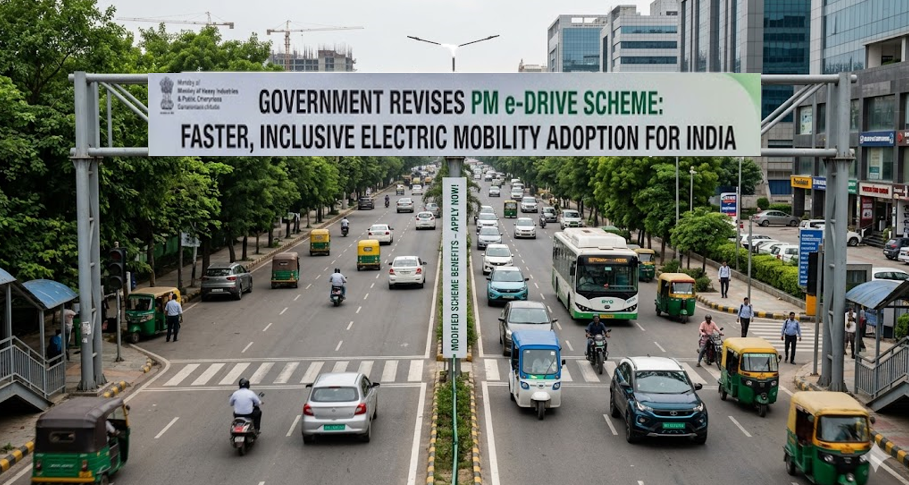
Context: The Government of India has revised provisions under the PM Electric Drive Revolution in Innovative Vehicle Enhancement (PM E-DRIVE) Scheme to streamline subsidy distribution and ensure efficient utilisation of allocated funds.
More on the News
• Revisions, notified by the Ministry of Heavy Industries, respond to achieved targets in some segments and prevent fund overruns in a capped-budget framework.
• With increasing EV penetration, the government has introduced clear timelines, price caps, and unit ceilings to prevent misuse and target benefits effectively.
• The revision comes amid rising adoption of electric vehicles (EVs) and the need to balance fiscal support with demand.
Key Changes Introduced
• Revised Deadlines: Electric two-wheelers (e-2W) qualify for incentives only if registered by July 31, 2026.
- For electric three-wheelers (e-3W, including rickshaws and carts), the cut-off date has been extended to March 31, 2028.
• Price Caps for Incentives: Ex-factory price limit set at ₹1.5 lakh for e-2W and ₹2.5 lakh for e-3W to focus subsidies on affordable models.
• Unit Limits: Total support capped at 24,79,120 e-2W and 39,034 e-3W (rickshaws/carts).
- L5 e-3W subcategory closed early on December 26, 2025, after meeting targets.
• Fund Exhaustion Clause: Scheme or components halt if the total outlay of the Scheme fixed at ₹10,900 crore depletes before March 31, 2028; no further claims will be accepted post-closure.
• Terminal Date Definition: The “terminal date” refers to the final cut-off for vehicle registration to claim incentives. Missing this deadline results in loss of eligibility, irrespective of scheme continuity.
About the PM E-Drive Scheme
• Launched in 2024 by the Ministry of Heavy Industries (MHI), now extended to 2028, the PM E-DRIVE initiative promotes mass mobility through the support of public transportation systems.
o It subsumes earlier transitional schemes like the Electric Mobility Promotion Scheme (EMPS), 2024.
• The key objective is to speed up the transition to electric vehicles by offering upfront incentives for EV purchases and encouraging the development of charging infrastructure.
• Key Components:
- Demand Incentives for e-2W, e-3W, e-ambulances, e-trucks and other emerging EV categories.
- Capital grants for e-buses, establishment of a network of charging stations.
• Eligible Vehicle Categories:
- Electric Two-Wheelers (e-2Ws): Incentives for 24.79 lakh advanced-battery e-2Ws, covering both commercial and private use.
- Electric Three-Wheelers (e-3Ws): Incentives for about 39,000 advanced-battery e-3Ws (e-rickshaws and e-carts), limited to commercial use.
- e-Ambulances: ₹500 crore allocated for e-ambulances, with standards set jointly by the Ministry of Health and Family Welfare (MoHFW) and MoRTH, etc., with eligibility criteria to be finalized with MoHFW.
- e-Trucks: ₹500 crore allocated for electric trucks, eligible only with MoRTH-approved scrapping certificates; subsidy, vehicle count, and norms to be announced subsequently.
- e-Buses: ₹4,391 crore has been allocated to procure 14,028 e-buses for public transport in nine major cities, with priority for those scrapping old buses.
- Charging Infrastructure: The scheme aims to establish a robust network of public charging stations to boost user confidence.
Other Govt Initiatives for Promotion of e-Vehicles
• National Electric Mobility Mission Plan (NEMMP) 2020: Launched in 2013, aimed for 6-7 million annual hybrid/EV sales by 2020 via demand incentives, R&D in batteries/power electronics, charging infra, and vehicle retrofitting to cut emissions.
• FAME India Scheme: Faster Adoption and Manufacturing of Hybrid and Electric Vehicles (FAME), served as India’s flagship EV program under NEMMP.
- Phase I (2015-19, ₹895 crore): Supported 2.8 lakh EVs, 425 e-buses, 520 charging stations.
- Phase II (2019-24, ₹10,000 crore): Expanded subsidies for e-2W/3W/4W, e-buses, more stations
• PLI Scheme for Automobile and Auto Component Industry (PLI-Auto): Introduced in 2021, this scheme incentivizes domestic production of advanced automotive technologies, including EVs, with a mandate for at least 50% domestic value addition.
• Scheme for Promotion of Manufacturing of Electric Passenger Cars (SPMEPCI) 2024: This policy attracts global automakers by allowing approved firms a five-year window to import completely built electric four-wheelers (minimum CIF value USD 35,000) at a reduced 15% customs duty, encouraging local manufacturing hubs under ‘Make in India’.
• PM e-Bus Sewa – Payment Security Mechanism (PSM) Scheme: Notified in 2024, it supports the deployment of over 38,000 electric buses by offering payment guarantees to operators against defaults by public transport authorities, scaling mass EV mobility nationwide.