
SYLLABUS
GS-2: Government Policies and Interventions for Development in various sectors and Issues arising out of their Design and Implementation.
GS-3: Indian Economy and issues relating to planning, mobilisation of resources, growth, development and employment; Inclusive Growth and issues arising from it.
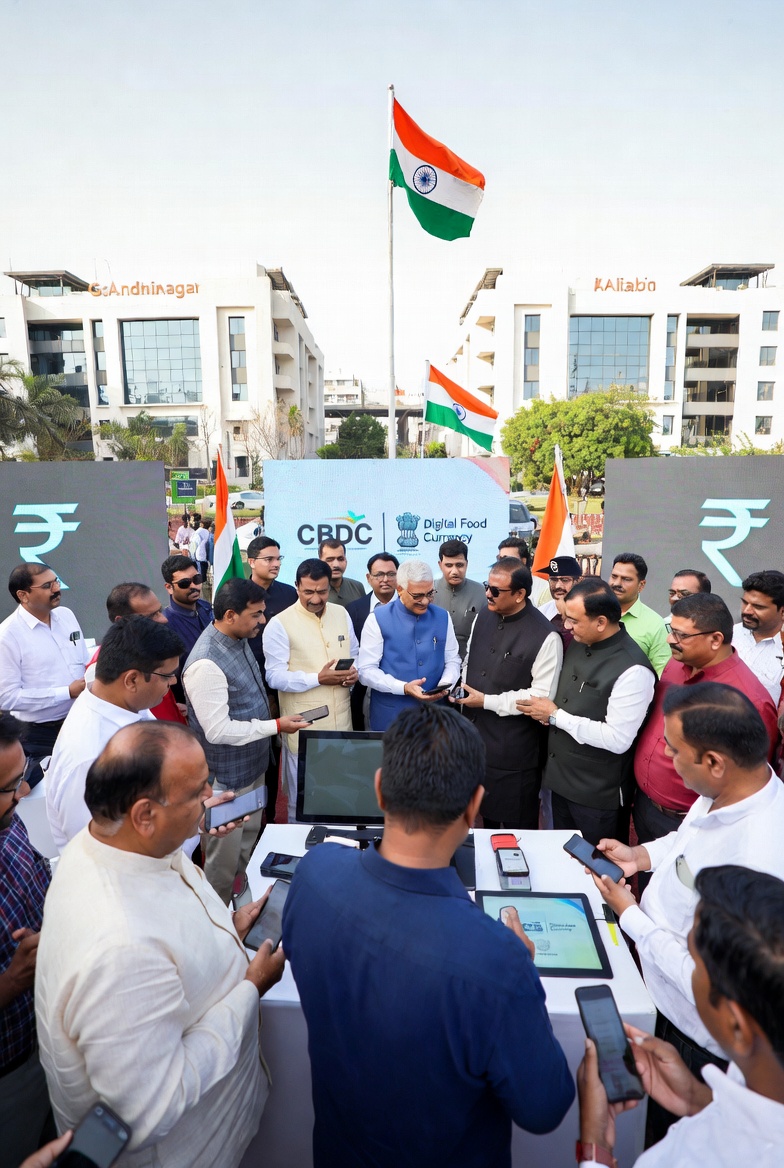
Context: Recently, the Government of India has launched the nation’s first Central Bank Digital Currency (CBDC)-based Digital Food Currency pilot in Gandhinagar, Gujarat.
More on the News
- This initiative integrates the Reserve Bank of India’s (RBI) programmable e-Rupee (e₹) into the Public Distribution System (PDS) to ensure transparent and corruption-free delivery of food subsidies.
- In its initial phase, it covers over 26,000 beneficiary families in four districts: Ahmedabad, Surat, Anand, and Valsad.
- Gujarat is the first state to test digital rupee-based ration distribution under the PDS.
- The government has indicated that the pilot will soon be extended to the Union Territories of Chandigarh, Puducherry, and Dadra and Nagar Haveli and Daman and Diu.
- Over the past several years, the government has undertaken several measures to transform India’s food security ecosystem, including –
- One Nation One Ration Card (ONORC),
- deployment of e-POS devices for Aadhaar-enabled authentication,
- data-driven validation through the Rightful Targeting Dashboard,
- Digital supply-chain optimisation through Ann Chakra and
- strengthened grievance redressal mechanisms such as Ann Sahayata.
Key Features
- Under the CBDC framework, digital coupons generated through the Reserve Bank of India will be credited directly to beneficiaries as programmable digital currency (e₹).
- Beneficiaries can redeem their entitled quantity of foodgrains at ration shops using CBDC coupons or voucher codes.
- The system will address challenges related to biometric authentication and e-POS operational issues while ensuring secure, traceable and real-time transactions.
- Monthly food subsidies are credited directly to beneficiaries’ RBI-enabled digital wallets as programmable tokens. These tokens carry specific details regarding the item, quantity, and price.
Benefits and Design
- Programmability: These digital coupons are “locked” and can only be used for ration purchases at authorised Fair Price Shops (FPS).
- Authentication: The system eliminates the need for repeated biometric authentication at the point of sale, using QR codes or voucher codes for transactions instead.
- Integration with ‘Annapurti’ ATMs: Beneficiaries can use their digital tokens at newly introduced ‘Annapurti’ Grain ATMs.
- The ‘Annapurti’ Grain ATM, developed by the UN World Food Programme (WFP) in collaboration with the Indian government, is an automated, biometric-enabled machine designed to dispense food grains (rice, wheat, pulses) 24/7.
- Transparency: By creating a real-time digital trail, the pilot aims to eliminate leakages, siphoning of grains, and the role of middlemen.
About Central Bank Digital Currency (CBDC)
- Central Bank Digital Currency (CBDC) is a digital form of sovereign currency issued and regulated by a country’s central bank.
- Unlike private cryptocurrencies, CBDCs are legal tender, backed by the state, and maintain a 1:1 value with physical cash.
- Digital Rupee is the electronic version of our currency, which can be used to carry out transactions or store value digitally, similar to the manner in which currency notes can be used in physical form.
- CBDCs are generally categorised based on their intended users:
- Retail CBDC (rCBDC): Designed for the general public for everyday transactions like shopping or P2P transfers. India’s retail pilot, launched in December 2022, now covers millions of users and is interoperable with UPI QR codes.
- Wholesale CBDC (wCBDC): Restricted to financial institutions for interbank settlements and large-value transactions. It aims to reduce settlement risks and improve the efficiency of the backend financial infrastructure.