
SYLLABUS
GS-2: Important aspects of governance; Probity in Governance: Concept of public service; Philosophical basis of governance and probity; Information sharing and transparency in government, Right to Information, Codes of Ethics, Codes of Conduct, Citizens’ Charters, Work culture, Quality of service delivery, Utilisation of public funds, challenges of corruption.
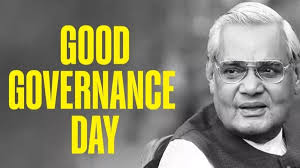
Context: Good Governance Day is observed annually on December 25 to honour the birth anniversary of former Prime Minister Atal Bihari Vajpayee.
More on the News
- The Union Minister of State for Personnel, Public Grievances and Pensions, inaugurated the fifth National Workshop on Good Governance Practices at the Civil Services Officers’ Institute, New Delhi.
- The workshop focuses on initiatives to enhance decision-making efficiency and review the outcomes of Special Campaign 5.0.
- On the occasion, the Minister unveiled new IT tools, including an AI-powered Recruitment Rules Generator, the eHRMS 2.0 mobile app, new features on the iGOT Karmayogi portal, and the Karmayogi Digital Learning Lab 2.0.
- Good Governance Week (Sushasan Saptah) is also observed nationwide from December 19 to 25 to improve service delivery, strengthen grievance redressal mechanisms, and promote citizen-centric administration.
- The ‘Prashasan Gaon Ki Ore’ initiative forms the core of the Good Governance Week campaign, placing district administrations at the forefront of grievance redressal and effective public service delivery.
- In 2025, India observed the 101st birth anniversary of former Prime Minister Atal Bihari Vajpayee.
About Good Governance Day
- In 2014, the Union government declared December 25 as “Good Governance Day” to honour the birth anniversary of former Prime Minister of India Atal Bihari Vajpayee.
- This day emphasises that governance should focus on improving citizens’ lives, not just on administration, and highlights the principles of Accountability, Transparency, and Inclusive Growth, which were central to Vajpayee’s leadership.
- In 2021, during Amrit Mahotsav (75th Year of Independence), the government introduced Sushasan Saptah to promote the concept of good governance across the country.
- The ‘Good Governance Index’ was launched on 25th December 2019, on the occasion of Good Governance Day.
About Good Governance

- According to the Good Governance Index Report
- Good Governance is defined as an effective and efficient process of decision-making.
- It involves the implementation (or non-implementation) of decisions, with the amelioration of citizens as the topmost priority.
- The process includes resource allocation, the creation of formal establishments, and the establishment of rules and regulations, all of which contribute to achieving this goal
- According to the United Nations, good governance encompasses eight key characteristics: participatory, consensus-oriented, accountable, transparent, responsive, effective, equitable, and inclusive, all while adhering to the rule of law.
- Good Governance in Indian Tradition:
- In ancient India, kings were guided by Rajadharma, the ethical and moral principles of governance.
- Epics like the Mahabharata and Ramayana emphasise the qualities of an ideal ruler, such as justice, fairness, and prioritising the welfare of the people.
- These timeless values still resonate today, reminding us that governance should always be rooted in integrity and compassion.