
SYLLABUS
GS-2: Important International Institutions, agencies and fora – their Structure, Mandate.
Context: The Global Risks Report 2026, prepared by the World Economic Forum (WEF), is the 21st edition of the annual report, marking the second half of a turbulent decade.
More on the News:
- The report analyses global risks through three timeframes to support decision makers in balancing current crises and longer-term priorities.
- It explores risks in the current or immediate term (in 2026),
- the short-to-medium term (to 2028),
- and in the long term (to 2036).
Key findings of the Report
- A new “Age of competition”: As global risks continue to spiral in scale, interconnectivity and velocity, 2026 marks an age of competition because of:-
- Crumbling Cooperative mechanisms
- Governments retreating from multilateral frameworks
- Confrontation replacing collaboration
- Trust – the currency of cooperation, is losing its value.
- Retreating Multilateralism: Declining trust, diminishing transparency and respect for the rule of law, along with heightened protectionism, are threatening longstanding international relations, trade and investment and increasing the propensity for conflict.
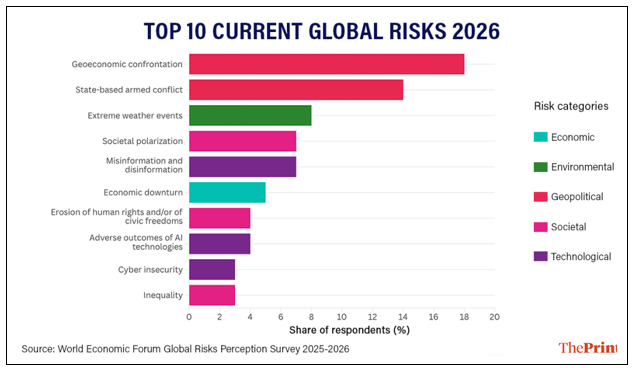
- Top global risk in 2026
- Geoeconomic confrontation: It is the top risk factor to trigger a material global crisis in 2026.
- State-based armed conflict: Ranked second, reflecting continuing geopolitical tensions and conflicts that could escalate.
- Intensifying Economic risks: Economic risks that includes Economic downturn, Geoeconomic confrontation, Asset bubble burst and Inflation, show the largest increases in ranking over the next two years, albeit from relatively low rankings last year.
- Unchecked Technological risks: Misinformation and disinformation, Cyber insecurity, and Adverse outcomes of frontier technologies like AI, leading to new risks across domains, from labour markets to information integrity to autonomous weapons systems.
- Societies are on the edge:
- Rising societal and political polarization is intensifying pressures on democratic systems.
- Growing prevalence of “streets versus elites” narratives reflects deepening disillusionment with traditional governance structures.
- Inequality, wealth concentration, rising cost of living, and permanently K-shaped economies question the social contract.
- Deprioritized Environmental concerns: Environmental risks like Extreme weather events, Pollution, Biodiversity loss and ecosystem collapse declined in severity score for the two-year time horizon compared with last year’s findings, reflecting an absolute shift away from concerns about the environment.

India-Specific Findings in the Report
- Top five risks as identified by the Executive Opinion Survey (EOS) 2025 include:
- Cyber insecurity,
- inequality (income and wealth),
- insufficient public services and social protections (education, pension, infrastructure),
- economic downturn (recession and stagnation) and
- state-based armed conflict (proxy, civil wars, coups, terrorism).
- Natural resources in Trade: India is increasingly using natural resources as leverage in trade and strategic negotiations.
- Potential Geopolitical Flashpoints:
- Indus River Basin water security issues with Pakistan
- Water diversion and resource pressures that could increase geopolitical tension with neighbours.
- Misinformation in Democracy: Recent elections in the United States, Ireland, the Netherlands, Pakistan, Japan, India and Argentina have all had to contend with such fabricated content on social media, depicting fictional events or discrediting political candidates, blurring the line between fact and fiction.
Key recommendations in the report
- Multipolarity with Multilateral: Strengthen multilateral frameworks and rebuild trust-based cooperation to manage global risks.
- Counter societal polarization: Strengthen media literacy, fact-checking frameworks, and transparent communication strategies to address the spread of misinformation and Deepfakes that undermine democratic processes and trust.
- Tech Governance: upgrade cyberdefenses, create adaptive rules for AI, and safeguard critical infrastructure.
- Bridge Social Protection Gaps: promote inclusive growth, Equity, social safety nets, and equitable access to services.