
SYLLABUS
GS-2: Bilateral, regional and global groupings and agreements involving India and/or affecting India’s interests.
GS-3: Indian Economy and issues relating to planning, mobilisation of resources, growth, development and employment.
Context: Recently, over 145 countries agreed to amend the 2021 OECD Global Minimum Tax deal to retain the 15 per cent rate while accommodating U.S. concerns.
More on the News
• The agreement was finalised under the aegis of the OECD (Organisation for Economic Co-operation and Development), which stated that the update enhanced tax certainty, reduced complexity and protected tax bases.
• The revised package retained the 15 per cent global minimum corporate tax framework.
• The update introduced simplifications and carve-outs to align U.S. minimum tax rules with global standards.
• The changes addressed objections raised earlier by the Trump administration, which argued the deal penalised U.S. multinationals.
• The revised pact stabilised the global tax framework after U.S. threats of withdrawal and retaliatory taxation.
• The agreement followed a June 2025 deal among G7 countries that exempted some U.S. firms from parts of the original framework.
- The G7 (Group of Seven) is an informal grouping of the world’s major advanced economies like US, Canada, Italy etc., formed in the mid-1970s with no permanent secretariat or binding charter.
• As of October 2025, more than 65 countries had already begun implementing the 2021 global tax deal.
Global Minimum Corporate Tax Agreement
• The global minimum corporate tax agreement was adopted in 2021 under the OECD Inclusive Framework.
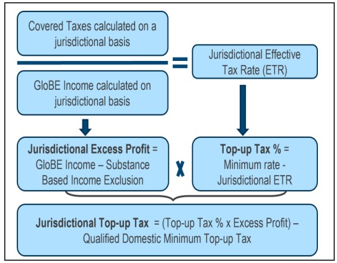
• The agreement led by the OECD aimed to ensure large multinational corporations (with over €750m revenue) pay a minimum 15% tax rate on profits in the country they operate.
• It sought to curb profit shifting to low-tax jurisdictions and prevent a race to the bottom in corporate taxation.
• The agreement allowed countries to impose a top-up tax if profits were taxed below the minimum rate elsewhere.
• It improved fairness in the international tax system by aligning taxation with real economic activity.
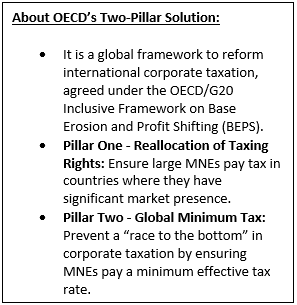
• It is part of Pillar Two of the OECD’s broader two-pillar solution for International tax reform.
About the OECD:
• It is an intergovernmental body established in 1961 that works to promote economic growth, financial stability, trade and improved living standards among member countries.
• Its headquarters are located in Paris, France.
• OECD has 38 member countries. The members include nations from Europe, the Americas, Asia, and Oceania that are committed to democracy and market economies.
• India is not a member of OECD.