

SYLLABUS
GS-3: Science and Technology—Developments and their Applications and Effects in Everyday Life; Achievements of Indians in science & technology; Indigenization of technology and developing new technology.
Context: India ranked 38th out of 139 economies in the Global Innovation Index (GII) 2026, retaining its position from 2025 and remaining the top-ranked economy in Central and Southern Asia.
About the Global Innovation Index (GII)
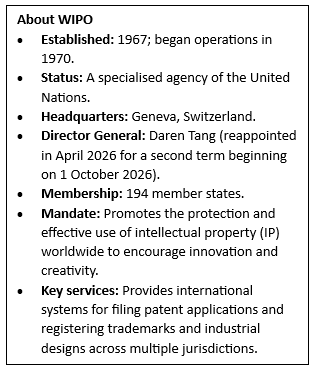
- The Global Innovation Index (GII) is an annual assessment published by the World Intellectual Property Organization (WIPO), a specialised agency of the United Nations. First introduced in 2007, the 2026 edition is its 19th edition.
- Origin: First introduced in 2007, the 2026 edition is its 19th edition.
- Purpose: The GII assesses how effectively economies develop and translate their capacity for innovation into tangible outcomes.
- Coverage: The 2026 edition ranks 139 economies using 79 indicators, covering areas such as research, education, infrastructure, business activity, technology and creative outputs.
- Methodology: The indicators are organised into two equally weighted sub-indices, comprising seven pillars in total.
- Innovation Input Sub-Index: Measures the conditions that support innovation through five pillars—Institutions; Human Capital and Research; Infrastructure; Market Sophistication; and Business Sophistication.
- Innovation Output Sub-Index: Measures the results of innovation through two pillars—Knowledge and Technology Outputs, and Creative Outputs.
- Overall ranking: The overall GII score is calculated as the average of the two sub-indices.
- Theme of GII 2026: “Powering Entrepreneurs at the Frontier of Science”, focusing on deep-science startups and the translation of scientific advances into commercial applications.
Key Global Findings
- A. Top-ranked economies
- Switzerland ranked first for the 16th consecutive year.
- The top five were Switzerland (1st), Sweden (2nd), the United States (3rd), the Republic of Korea (4th) and Singapore (5th).
- China ranked 10th, remaining the only middle-income economy in the global top 30.
- B. Regional leaders
- Northern America: United States
- Latin America and the Caribbean: Chile
- Europe: Switzerland
- Northern Africa and Western Asia: Israel
- Central and Southern Asia: India
- South-East Asia, East Asia and Oceania: Republic of Korea
- Sub-Saharan Africa: Mauritius
- C. Leaders by income group
- High-income economies: Switzerland
- Upper-middle-income economies: China
- Lower-middle-income economies: India
- Low-income economies: Rwanda
- D. Global innovation clusters
- Top three clusters: Shenzhen–Hong Kong–Guangzhou (1st), Tokyo–Yokohama (2nd) and San Jose–San Francisco (3rd).
- These clusters are assessed using concentrations of patent activity, scientific publications and venture-capital activity.
- Distribution of the top 100 clusters: China had 25 clusters, the United States 20, Germany seven, and India and the United Kingdom four each.
- Top three clusters: Shenzhen–Hong Kong–Guangzhou (1st), Tokyo–Yokohama (2nd) and San Jose–San Francisco (3rd).
India’s Performance in GII 2026
- Overall position: India ranked 38th among 139 economies, first among 36 lower-middle-income economies and first among 11 economies in Central and Southern Asia.
- Ranking trend: India improved from 48th in 2020 to 38th in 2025 and maintained the same position in 2026.
- Inputs versus outputs: India ranked 49th in the Innovation Input Sub-Index and 25th in the Innovation Output Sub-Index.
- Its stronger relative performance in outputs indicates that its measured innovation results rank higher than the conditions supporting innovation.
- Pillar-wise performance:
- Strongest pillars: Knowledge and Technology Outputs (15th) and Market Sophistication (35th).
- Lowest-ranked pillars: Business Sophistication (63rd), Infrastructure (62nd) and Institutions (60th).
- Indian innovation clusters: Four Indian clusters featured in the global top 100:
- Bengaluru — 25th; Delhi — 27th; Mumbai — 43rd; Chennai — 79th.
- Notable strengths: India ranked first in ICT services exports, third in domestic market scale, fourth in late-stage venture-capital deal count and eighth in finance for startups and scale-ups.
- Areas of weakness: India ranked 83rd in researchers per million population, 94th in electricity output per million population and 98th in knowledge-intensive employment.