

SYLLABUS
GS-2: Issues relating to the development and management of Social Sector/Services relating to Health.
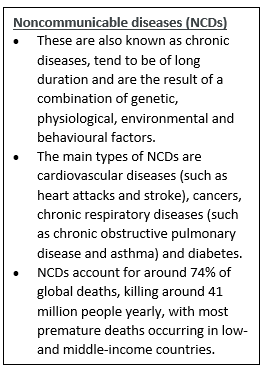
Context: Recently, world leaders at the Eightieth United Nations General Assembly (UNGA) adopted a landmark political declaration committing governments to jointly address non-communicable diseases (NCDs) and mental health challenges.
More on the News
- The declaration is an outcome of the fourth High-Level Meeting of the UNGA on the prevention and control of NCDs and the promotion of mental health and well-being.
- The declaration is titled “Equity and integration: transforming lives and livelihoods through leadership and action on non-communicable diseases and the promotion of mental health and well-being”.
- The World Health Organisation stated that this is the first time countries have collectively pledged to address chronic non-communicable diseases and mental health conditions together.
- The declaration recognises that NCDs cause around 18 million premature deaths each year, while mental health conditions affect more than one billion people globally and are rising across all regions and income groups.
- The declaration aligns with SDG Target 3.4, which aims to reduce premature mortality from NCDs by one-third and promote mental health and well-being by 2030.
Key Highlights of the Declaration
- The new political declaration establishes three first-ever global “fast-track” outcome targets to be achieved by 2030:
- 150 million fewer tobacco users,
- 150 million more people with hypertension under control, and
- 150 million more people with access to mental health care.
- To ensure countries can reach these goals, the declaration also sets ambitious, measurable process targets for national systems by 2030, including:
- at least 80% of countries with policy, legislative, regulatory and fiscal measures in place
- at least 80% of primary health care facilities with access to affordable, WHO-recommended essential medicines and basic technologies for NCDs and mental health
- at least 60% of countries implementing financial protection policies or measures that cover or limit the cost of essential NCD and mental health services
- at least 80% of countries with operational, multisectoral national plans for NCDs and mental health
- at least 80% of countries with robust surveillance and monitoring systems for NCDs and mental health.
Significance of the Declaration
- Broadening the Global NCD Framework: The declaration broadens the NCD framework to include neglected diseases and, for the first time, integrates NCDs with mental health, promoting a holistic, life-course approach.
- Stronger Accountability and Systems: Introduces time-bound 2030 targets and urges strengthening of national health systems, financing and service delivery.
- Integrated and Preventive Health Governance: By jointly addressing non-communicable diseases and mental health and acknowledging environmental and commercial determinants (air pollution, unsafe cooking fuels, harmful chemicals, unhealthy food and tobacco products), the declaration advances an integrated, prevention-oriented global health strategy.
- Equity-centred Commitment: Prioritises vulnerable populations, including climate-affected communities, Small Island Developing States and those in humanitarian settings.
Source:
Who
Premiumtimesng
Alzheimer