
SYLLABUS
GS-I Prelims: Current events of national and international importance.
GS-3: Indigenization of Technology and Developing New Technology; Awareness in the fields of IT, Space.
Context: Recently, at the 6th India–France Annual Defence Dialogue in Bengaluru, India conveyed its interest in joining France’s sixth-generation fighter project under the Future Combat Air System (FCAS) framework.
More on the News
• Defence Minister Rajnath Singh indicated India’s willingness to explore co-development and co-manufacturing of a sixth-generation combat aircraft under the FCAS framework.
• India’s interest in FCAS comes alongside the development of its own Advanced Medium Combat Aircraft (AMCA) fifth-generation programme.
- The AMCA programme’s first flight is expected around 2028–29, with induction targeted around 2035.
• Alongside fighter aircraft talks, India also pitched export of the indigenous Pinaka multi-barrel rocket launcher system to France.
• In recent years, India’s defence exports have risen to over ₹23,000 crore, while the government has set a target of achieving ₹3 lakh crore in defence manufacturing and ₹50,000 crore in defence exports by 2029.
About the Future Combat Air System (FCAS)
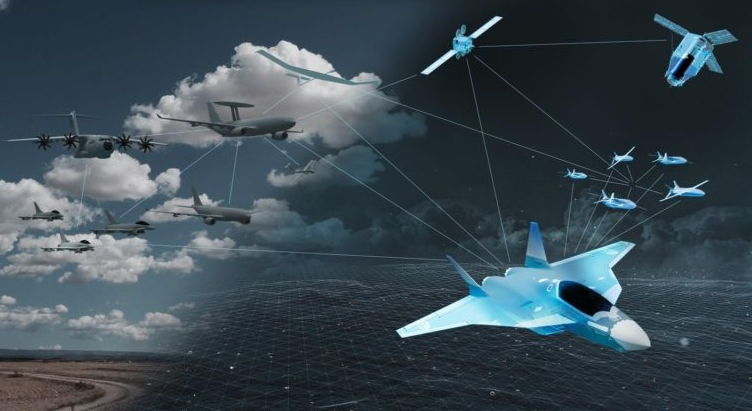
• The Future Combat Air System (FCAS) is a European defence programme aimed at developing a sixth-generation air combat ecosystem.
• It was initially launched by France and Germany in 2017, with Spain joining the programme in 2019.
• FCAS is not just a fighter aircraft project but a system-of-systems concept designed to integrate multiple combat platforms.
• The programme revolves around a Next Generation Fighter (NGF), a sixth-generation stealth aircraft, supported by:
- Unmanned combat aerial systems (UCAVs)
- Remote carrier drones
- Artificial intelligence-enabled decision support systems
- All systems connected through a secure “combat cloud”.
• The system aims to operate in a network-centric battlefield environment, enabling coordinated operations between manned and unmanned platforms.
• The FCAS is expected to enter operational service around 2040, replacing older aircraft such as the Rafale and Eurofighter in European air forces.
Significance for India
• Access to Advanced Military Technology: Participation could provide India with exposure to emerging technologies such as AI-enabled combat systems, advanced stealth design and autonomous drones.
• Strengthening Strategic Partnership with France: Defence cooperation between India and France has expanded significantly in recent years, including aircraft procurement and joint military exercises.
• Boost to Indigenous Aerospace Industry: Collaboration could enhance domestic manufacturing capabilities and support the development of India’s aerospace ecosystem.
• Complement to India’s AMCA Programme: Technological insights from FCAS may support India’s ongoing efforts to develop a fifth-generation stealth fighter and future combat platforms.
About Sixth-Generation Fighter Systems
• Sixth-generation fighter aircraft represent the next evolution of combat aviation, succeeding current fifth-generation stealth fighters such as the USA’s F-35, Russia’s Su-57, and China’s J-20.
• Unlike earlier fighters, sixth-generation systems are designed as integrated combat networks rather than standalone aircraft.
• These aircraft are expected to feature:
- Advanced stealth and low-observable technologies
- Artificial intelligence-assisted decision systems
- Manned-unmanned teaming with autonomous drones
- Directed-energy weapons and advanced sensors
- High-speed data links for network-centric warfare
• Apart from FCAS, other major projects in this domain include the Global Combat Air Programme (GCAP) of the UK–Italy–Japan consortium, and Next Generation Air Dominance (NGAD) programme of the United States.