
SYLLABUS
GS-3: Indian Economy and issues relating to planning, mobilization of resources, growth, development and employment.
Context: Recently, NITI Aayog released the second edition of the Fiscal Health Index (FHI) 2026, providing a comprehensive assessment of the fiscal performance of Indian states.
About the Fiscal Health Index (FHI)
- The Fiscal Health Index (FHI) is a data-driven framework developed by NITI Aayog to assess and compare the fiscal performance of Indian states.
- It was conceptualised to evaluate fiscal soundness, guide reforms, and promote evidence-based fiscal policymaking in the states.
- The Index provides systematic benchmarking across states, helping identify fiscal strengths, weaknesses, and areas requiring policy intervention.
- The need for such an assessment has increased as state governments play a crucial role in India’s fiscal architecture and account for nearly one-third of the country’s general government debt.
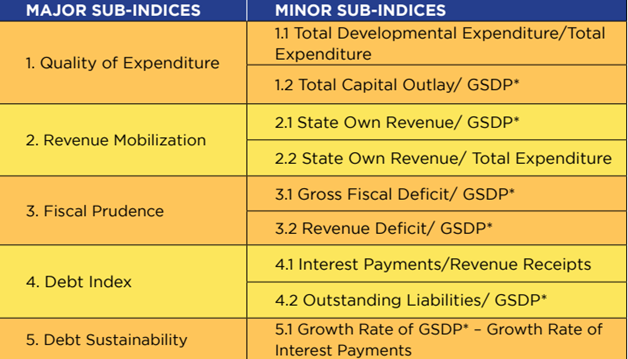
- The composite FHI is developed using data from the Comptroller and Auditor General (CAG) and focuses on five sub-indices:
- Quality of Expenditure
- Revenue Mobilization
- Fiscal Prudence
- Debt Index
- Debt Sustainability
- The first edition (2025) assessed 18 major states, while the second edition expands coverage to include 10 North-Eastern and Himalayan states, making the Index more inclusive and representative of India’s fiscal diversity.
- Due to structural differences such as geographical remoteness, limited revenue capacity, sparse population, and higher service delivery costs, North-Eastern and Himalayan states are ranked separately from major states.
- The Index also provides longitudinal analysis of fiscal trends from FY 2014-15 to FY 2023-24, offering insights for policymakers, researchers, and stakeholders.
- It aligned with India’s broader vision of achieving “Viksit Bharat @2047.”
Key Findings of the Index
- Overall Fiscal Trends: Fiscal outcomes vary significantly across states, reflecting differences in fiscal discipline, revenue mobilisation, and expenditure management.
- Among the 18 major states, several recorded moderate FHI scores in 2023-24, indicating emerging fiscal pressures.
- States with stronger fiscal discipline and revenue mobilisation generally rank higher, while lower-ranked states exhibit higher non-developmental expenditure and weaker fiscal sustainability.
- Performance of Major States: Odisha remains the top performer, supported by controlled deficits and stable revenues.
- Goa and Jharkhand also feature among the Achiever states, while Gujarat and Maharashtra remain within the top five.
- Haryana recorded a notable improvement in ranking.
- Bihar, Karnataka, and Telangana show mild recovery, while Chhattisgarh, Tamil Nadu, and Rajasthanexperienced rank declines due to weakening fiscal indicators.
- Punjab, West Bengal, Kerala, and Andhra Pradesh remain under fiscal stress with rising debt levels, sustained deficits, and modest revenue growth.
- Achiever States (Odisha, Goa, Jharkhand)
- High own-tax share (above 60%)
- Large capital outlay (around 4–5% of GSDP)
- Fiscal deficit below 3% of GSDP
- Moderate debt (below 25% of GSDP)
- Front-Runner States: Gujarat, Maharashtra, Chhattisgarh, Telangana, Uttar Pradesh, Karnataka
- Performer States: Madhya Pradesh, Haryana, Bihar, Tamil Nadu, Rajasthan
- Aspirational States: West Bengal, Kerala, Andhra Pradesh, Punjab
- Characterised by high debt (35–45% of GSDP), persistent deficits, high committed expenditure (50–60% of revenue receipts), and large interest burdens.
- Performance of North-Eastern and Himalayan States: These states are ranked separately and classified into:
- Achievers: Arunachal Pradesh, Uttarakhand
- Performers: Assam, Meghalaya, Mizoram, Sikkim, Tripura
- Aspirational: Himachal Pradesh, Manipur, Nagaland
- Arunachal Pradesh ranks highest due to strong expenditure quality and prudent debt management.
- Uttarakhand performs well due to strong own-revenue mobilisation.
- Tripura shows good debt sustainability, while Meghalaya and Assam display mixed performance across indicators.
- Himachal Pradesh and Manipur remain constrained by high committed expenditure and weak revenue mobilisation.
- Several states rely heavily on Union transfers, with some receiving over 80% of their revenue from central transfers.
- Policy Priorities Identified: The report highlights several reforms to strengthen fiscal health:
- Enhancing revenue mobilisation, especially by strengthening the state’s own-tax capacity and broadening the GST base.
- Rationalising committed expenditures such as salaries, pensions, and subsidies to improve fiscal flexibility.
- Improving the quality and composition of capital expenditure.
- Adopting medium-term fiscal planning frameworks to manage deficits and debt trajectories.
- Monitoring off-budget borrowings and strengthening public financial management systems.
- Improving transparency using CAG-verified fiscal data and benchmarking through tools like the Fiscal Health Index.
About the NITI Aayog (National Institution for Transforming India)
- On January 1, 2015, the NITI Aayog was established as the successor to the Planning Commission, created by an executive resolution from the Government of India (Union Cabinet).
- it is a non-constitutional (not created by the Constitution) and non-statutory (not created by an Act of Parliament) body.
- Role and Function of NITI Aayog:
- NITI Aayog serves as the premier policy think tank of the Government of India, providing both directional and policy inputs.
- NITI Aayog is responsible for designing strategic and long-term policies and programs for the Government of India.
- It also provides technical advice to both the Centre and States.
- The one-way flow of policy from the Centre to States, characteristic of the Planning Commission era, is being replaced with a genuine partnership between the Centre and States.
- NITI Aayog encourages a collaborative approach, as opposed to the command-and-control method of the past.
- In line with the spirit of federalism, NITI Aayog operates on a bottom-up approach, shaping its policy thinking by considering inputs from various stakeholders, rather than the traditional top-down model.
- The NITI Aayog Composition:
- Chairperson: The Prime Minister of India.
- Governing Council: Includes Chief Ministers of all States, Chief Ministers of Union Territories with legislatures, and Lt. Governors of other Union Territories.
- Regional Councils: Formed to address issues affecting multiple states/regions, convened by the Prime Minister, chaired by the Chairperson or their nominee.
- Special Invitees: Experts and specialists nominated by the Prime Minister.
- Full-time Organisational Framework:
- Vice-Chairperson: Appointed by the Prime Minister, with Cabinet Minister rank.
- Full-time Members: Hold the rank of Minister of State.
- Part-time members, ex-officio members, chief executive officer and secretariat.