
SYLLABUS
GS-3: Indian Economy and issues relating to planning, mobilization of resources, growth, development and employment.
Context: Recently, the Ministry of Statistics and Programme Implementation (MoSPI) released CPI data with a base year of 2024.
More on the News
- January 2026 retail inflation stood at 2.75%, marking the first inflation reading under the revised methodology.
- The new series replaces the CPI with base year 2012 and reflects structural shifts in the Indian economy, such as urbanisation, digitalisation, and changing consumption patterns.
- Inflation Highlights:
- Headline CPI inflation: 2.75%
- Rural inflation: 2.73%
- Urban inflation: 2.77%
- Food inflation: ~2.13%
- Housing inflation: ~2.05%
- Inflation remained within the RBI’s 2–6% target band.
- Tomato prices rose sharply, while onion, potato, and garlic prices declined significantly. Jewellery inflation remained elevated, especially for silver.
What is CPI, and Why is the Base Year Revised?
- The CPI measures changes in prices of goods and services consumed by households and serves as a key indicator of cost-of-living inflation.
- The CPI is the Reserve Bank of India’s primary inflation gauge and plays a central role in monetary policy and interest rate decisions.
- The base year is the reference point against which price changes are measured, with its index fixed at 100.
- As household consumption patterns evolve, the base year is periodically updated to ensure the index remains representative.
- The earlier CPI series (base 2012) had become outdated due to major structural shifts such as rising incomes, urbanization, digitalization, expansion of services, and changing consumption patterns.
- The revision aligns with IMF recommendations of updating CPI baskets periodically.
- The new series is based on the Household Consumption Expenditure Survey (HCES) 2023–24, ensuring alignment between consumption weights and current price structures.
- MoSPI also aligned the weight reference period with the price reference period to minimise base-year bias.
Key Changes
- Updated Base Year: The base year has been revised from 2012 to 2024.
- The price reference period is January–December 2024, while weights are derived from HCES 2023–24.
- Expanded Consumption Basket: The total number of items increased from 299 to 358, with goods rising to 308 and services to 50.
- This reflects the growing importance of services in household consumption.
- New additions include OTT subscriptions, digital storage devices, exercise equipment, babysitters, and rural housing rent.
- Obsolete items such as VCRs, cassette players, and other outdated electronics have been removed.
- Adoption of COICOP 2018: The new CPI adopts the UN’s COICOP 2018 classification framework.
- This replaces six broad groups with a detailed hierarchy of 12 divisions, 43 groups, 92 classes, and 162 subclasses.
- This improves global comparability and enables more granular inflation tracking. Minor adaptations were made to reflect Indian consumption patterns.
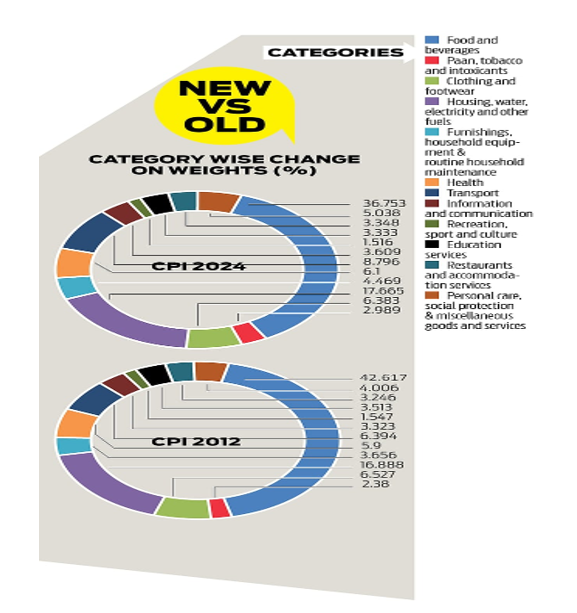
- Revised Weights: Weights were updated using HCES 2023–24 data.
- The food weight declined from about 45.9% to around 36.75%, reflecting rising incomes and diversification of consumption.
- Housing weight increased to about 17.67%, while transport, health, and services also gained higher shares.
- The reduced food weight is expected to lower inflation volatility.
- Housing Index Revision: The housing index now includes rent, maintenance, and utilities.
- Rural housing rent has been included for the first time, improving national representativeness.
Methodological Changes
- Modernised Data Collection: Data collection has shifted to tablet-based Computer Assisted Personal Interviewing (CAPI). This enables real-time validation, geo-tagging of shops, and faster data processing.
- Wider Market Coverage: Rural market coverage has expanded to 1,465 villages, while urban coverage exceeds 1,400 markets across over 430 towns.
- Online markets have been added in 12 major cities to capture e-commerce price trends.
- Alternative Data Sources: Administrative data is used for fuel prices, rail fares, and postal charges.
- Online sources are used for airfares, telecom plans, and OTT subscriptions. This improves data accuracy and reduces field errors.
- Improved Methodology: The Long Jevons method has been replaced by a chain-based price measurement approach.
- This allows smoother handling of product replacements and quality changes.
- Centralised pricing is used for regulated items, and free items are excluded as CPI measures prices actually paid by households.
Source:
Thehindu
Pib
Indianexpress
Newindianexpress
Economictimes