

SYLLABUS
GS-3: Conservation, environmental pollution and degradation, environmental impact assessment.
Context: According to the United Nations Financing for Sustainable Development Report 2026, global development financing is moving in the wrong direction, with SDG progress stalling or reversing due to rising geopolitical tensions, trade fragmentation, declining aid, and weakening multilateral cooperation.
About the Report
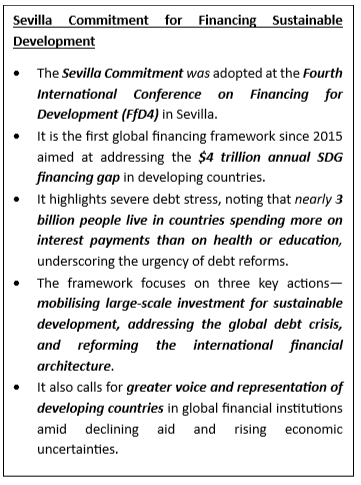
- The Financing for Sustainable Development Report 2026 (FSDR 2026) is the 10th edition of the flagship UN report and the first assessment after the 2025 Sevilla Commitment (FFD4), providing a global review of development financing trends.
- It is prepared by the Inter-agency Task Force on Financing for Development, comprising 60+ UN agencies, programmes, regional commissions, and major institutions such as IMF, World Bank, WTO, UNCTAD, and UNDP, coordinated by UN DESA.
- The report evaluates the global macroeconomic environment, identifies financing challenges and risks, and assesses their implications for achieving the Sustainable Development Goals (SDGs).
- It provides a mapping and early progress review of commitments made under the Sevilla framework, including reforms related to investment, debt sustainability, and international financial architecture.
- The report gives detailed analysis of:
- Private business and finance.
- International trade.
- International financial architecture and systemic issues.
- Data, monitoring, and follow-up mechanisms.
Key Findings
- Severe Financing Squeeze in Developing Countries: Developing nations face large unmet SDG financing needs amid:
- High borrowing costs and fiscal pressures
- Climate-related expenses and environmental degradation
- Structurally low tax revenues (77 countries below 15% tax-to-GDP threshold)
- Rising Debt Burden: Debt service reached 20-year highs in 2024.
- In several countries, it exceeds 20% of government revenue, crowding out spending on health, education, and infrastructure
- Borrowing costs surged (average bond rates for low-income countries rose to 8.4% in 2025)
- Sharp Decline in External Financing:
- Official Development Assistance (ODA): Fell 6% in 2024 and projected to decline further (up to 25% for LDCs) .
- Foreign Direct Investment (FDI): Dropped 11% in 2024, continuing a downward trend.
- International project finance: Fell 40% (2021–2024), impacting infrastructure and energy projects
- Trade Barriers and Fragmentation Increasing:
- The global trade environment is becoming more restrictive, with tariffs on LDC exports rising from 9% to 28% (2025), and tariffs for developing countries (excluding China) increased sharply.
- Fragmentation is reshaping trade flows and global value chains, investment patterns (especially in strategic sectors like semiconductors), and financial systems (e.g., alternatives to SWIFT emerging).
- Fragile but Resilient Global Economy: Global GDP growth was 2.8% in 2025 (below pre-pandemic average).
- Risks include Middle East conflict impacts, financial market corrections and Climate disasters.
- Despite challenges, some resilience was observed in renewable energy investment, which reached $2.2 trillion (2024), and South-South trade increased significantly over two decades.
- Impact of Fragmentation on Development:
- Geopolitical divisions are increasing capital volatility, raising the cost of finance, and weakening multilateral institutions.
- Fragmentation complicates WTO reforms, Global financial coordination and Climate action and debt resolution.
- Risk to SDG Progress: Without urgent action:
- Governments may cut development spending further.
- Progress toward SDGs could reverse significantly before 2030.
- Way Forward: The report recommends five priority action areas:
- Scale up financing and investment to close SDG gaps
- Align finance with sustainable development goals
- Invest in resilience against economic and climate shocks
- Adopt multilayered international cooperation (national + regional + global)
- Strengthen and reform multilateralism, rather than retreat from it