
SYLLABUS
GS-3: Indian Economy and issues relating to planning, mobilisation of resources, growth, development and employment.
Context: Recently, the Reserve Bank of India (RBI) released the December 2025 Financial Stability Report to assess the resilience of the Indian financial system and identify risks to financial stability.
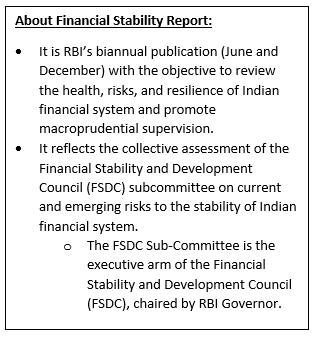
Key highlights of the report
- Global economy:
- Showing resilience, supported by fiscal measures, front-loaded trade, and strong AI-related investment.
- Downside risks persist due to still elevated uncertainty, high public debt, and the risk of a disorderly market correction.
- Growing underlying vulnerabilities in Global financial markets: Sharp rise in equities and other risk assets, the expanding role of non-bank financial intermediaries and their deepening interconnectedness with banks, and the growth of stablecoins all heighten global financial system fragilities.
- A stablecoin is a cryptocurrency whose value is designed to be stable, typically by being pegged to a fiat currency like the U.S. dollar.
- Resilient Indian Economy: Despite an uncertain and challenging global economic backdrop, it continues to grow strongly, underpinned by robust domestic demand, benign inflation, and prudent macroeconomic policies.
- SCBs financial health: The health of the scheduled commercial banks (SCBs) remains sound with strong capital and liquidity buffers, improved asset quality and robust profitability.
- Positive Macro stress test results:
- SCBs to withstand losses under hypothetical adverse scenarios and maintain capital buffers well above the regulatory minimum.
- Stress tests also confirm the resilience of mutual funds and clearing corporations.
- Non-banking financial companies (NBFCs) remain robust, supported by strong capital buffers, solid earnings, and improving asset quality.
- The insurance sector continues to display balance sheet resilience, and the consolidated solvency ratio remained above the minimum threshold limit.
Source:
Business Standard
RBI