
SYLLABUS
GS-3: Conservation, environmental pollution and degradation, environmental impact assessment.
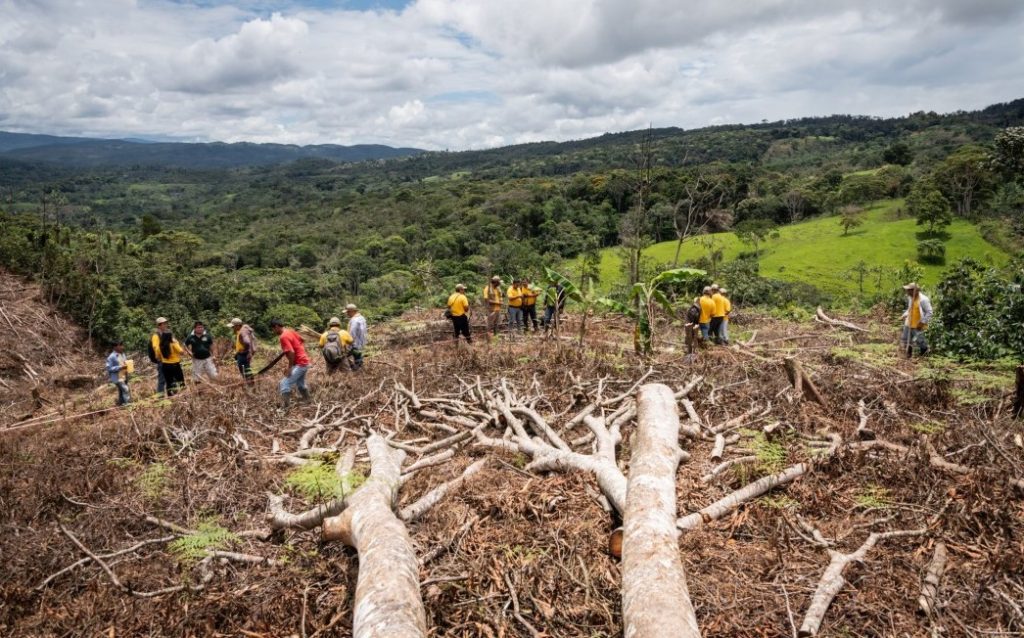
Context: A global study published in the journal Communications Earth & Environment warned that the conversion of natural habitats to farmland led to a 26 per cent decline in species richness, with India’s Western Ghats among the worst-affected regions.
More on the News
- The study was led by researchers from the Chinese Academy of Sciences and China Agricultural University, to examine the impact of agricultural expansion within biodiversity hotspots across the world.
- Researchers from the University of Cambridge, the University of Maryland and the University of Oklahoma collaborated in the study.
Key Highlights of the Study
- The study focused on small-range vertebrates such as mammals, birds and amphibians with limited geographic distribution.
- Total abundance of animals and plants declined by around 12 per cent in Biodiversity hotspot areas converted to agriculture.
- Community diversity adjusted for population size fell by nearly 9 per cent.
- Community diversity means the variety of different species living and interacting in a specific area, reflecting the richness of life forms and their interactions within that ecosystem, contributing to its overall stability and health.
- Wildlife data were analysed using the global PREDICTS database by comparing intact habitats with farmlands.
- Satellite imagery showed that cropland within biodiversity hotspots expanded by 12 per cent between 2000 and 2019, faster than the global average of 9 per cent.
- Agricultural expansion was most intense in tropical regions near the equator, which also host the highest biodiversity.
- Major affected regions included the Cerrado and Atlantic Forest in South America, Indo Burma and Sundaland in Southeast Asia and parts of Africa.
- The study identified 3,483 high-risk zones across biodiversity hotspots covering about 1,741 million hectares, out of which nearly 1,031 million hectares were located outside protected areas.
- Protected areas are locations that receive protection because of their recognized natural or cultural values.
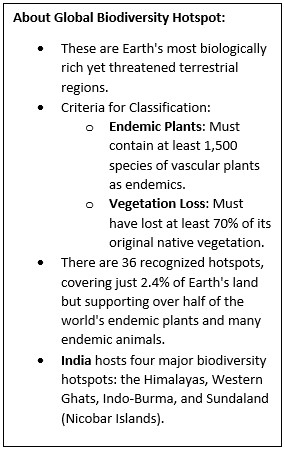
- In India, the Western Ghats showed similar patterns of accelerating land use change due to agriculture.
- The International Union for Conservation of Nature (IUCN) has rated the Western Ghats as being of “significant concern” in its 2025 World Heritage Outlook 4 report.
- India’s western ghat is a global Biodiversity Hotspot recognized by UNESCO, and home to over 5,000 flowering plants, 139 mammals, 508 birds and at least 325 globally threatened species.
- Experts warned that without targeted protection and sustainable farming practices, mass extinctions could intensify.
Key recommendations in the report:
- Protected areas: Expand the protected areas strategically in biodiversity hotspots, particularly where rare species with limited ranges are concentrated.
- Strengthen Protection: Management and enforcement inside existing protected areas must be strengthened to ensure actual wildlife safeguard.
- Agri-productivity: Improve farm productivity on land already being cultivated instead of clearing new areas.
- Increase International cooperation on food trade: Ensure biodiversity-rich but economically struggling countries aren’t forced to destroy their ecosystems to feed wealthier nations.
- Involve local communities: Recognise the Indigenous people’s role in protecting and monitoring as an integral part of the conservation efforts.
Significance of the study
- Ecological Impact: The study highlighted agriculture as a major driver of biodiversity loss within global biodiversity hotspots.
- Scientific Evidence: The study provided quantitative evidence of species decline in fragile ecosystems due to land use change.
- Conservation Gaps: The study revealed critical protection gaps as a large share of high-risk biodiversity zones lay outside protected areas.
- Policy and Planning: The study emphasised the urgent need to integrate conservation priorities with sustainable farming practices to prevent ecosystem collapse