
SYLLABUS
GS-2: Welfare schemes for vulnerable sections of the population by the Centre and the States and the performance of these schemes.
Context: Recently, the Union Cabinet approved the proposal of the Ministry of Jal Shakti to extend and restructure the Jal Jeevan Mission until December 2028.
More on the News
• The restructuring shifts the mission’s focus from infrastructure creation to reliable service delivery supported by strong drinking water governance and institutional systems.
• The government increased the total outlay of the mission to ₹8.69 lakh crore. The central assistance has been enhanced to ₹3.59 lakh crore from the earlier ₹2.08 lakh crore approved during the launch in 2019.
• A national digital framework named “Sujalam Bharat” will be introduced to digitally map the entire drinking water supply chain from source to household tap.
o Under this framework, every village will receive a unique Sujal Gaon/Service Area ID to strengthen transparency, monitoring, and accountability.
• The programme introduces “Jal Arpan”, under which Gram Panchayats (GPs) and Village Water and Sanitation Committees (VWSCs) will participate in commissioning and formal handover of completed schemes.
• A Gram Panchayat will declare itself “Har Ghar Jal” only after confirming that adequate operation and maintenance systems have been established for sustained water supply.
• The government will also promote Jal Utsav, an annual community-led event aimed at reviewing water systems and encouraging collective responsibility for maintenance.
• The government plans to achieve universal rural tap water coverage for all 19.36 crore rural households by December 2028 through the next phase called JJM 2.0.
About Jal Jeevan Mission
• The Jal Jeevan Mission was launched in August 2019 to provide Functional Household Tap Connections (FHTC) to every rural household in India.
• The mission aims to ensure a safe and adequate drinking water supply of at least 55 litres per capita per day to every rural household through piped connections.
• The mission emphasises community participation through the involvement of GPs and VWSCs in planning and managing water supply systems.
• The broad objective of the mission:
- Providing Functional Household Tap Connection (FHTC) to every rural household.
- Prioritising FHTC provision in quality-affected areas, drought-prone regions, desert areas and Sansad Adarsh Gram Yojana (SAGY) villages.
- Ensuring functional tap connections in schools, Anganwadi centres, gram panchayat buildings, health and wellness centres, and community buildings.
- Promoting voluntary ownership among the local community through contributions in cash, kind, or labour (shramdaan).
- Ensuring the sustainability of water supply systems, including water sources, infrastructure, and funding for regular operations and maintenance.
- Empowering and developing human resources in the water sector, covering construction, plumbing, electrical work, water quality management, water treatment, catchment protection, and more.
• To achieve the objectives of the Jal Jeevan Mission, the following components have been envisaged:
- In-Village Piped Water Supply Infrastructure – Development of piped water systems within villages to ensure tap water connections to every rural household.
- Sustainable Drinking Water Sources – Development of reliable drinking water sources and/or augmentation of existing sources to provide long-term sustainability to the water supply system.
- Bulk Water Transfer and Distribution – Establishment of bulk water transfer systems, treatment plants, and distribution networks.
- Technological Interventions for Water Quality – Implementation of technologies to remove contaminants where water quality is an issue.
- Retrofitting of Existing Schemes – Upgrading completed and ongoing schemes to provide Functional Household Tap Connections (FHTCs) at a minimum service level of 55 litres per capita per day (lpcd).
Achievements of the Mission
• The mission expanded rural tap water access from 3.23 crore (17%) households in 2019 to about 15.80 crore households, covering more than 81% of rural households in the country.
• SBI Research has reported that JJM has freed 9 crore women from fetching water, enabling greater participation in other economic activities.
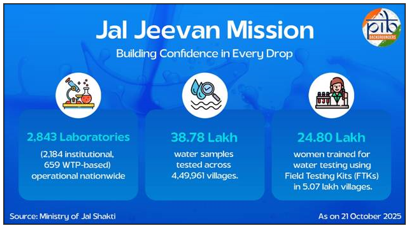
• According to the World Health Organization (WHO), universal access to safe drinking water has resulted in a reduction in women’s drudgery by saving 5.5 crore hours daily, prevention of 4 lakh diarrheal deaths, and savings of 14 million Disability Adjusted Life Years (DALYs).
• Nobel laureate Prof. Michael Kremer estimated a potential of 30% reduction in under-five mortality, saving 1,36,000 lives annually.
• JJM has created ~59.9 lakh direct and 2.2 crore indirect person years of employment, per IIM Bangalore and ILO estimates, bolstering rural livelihoods.
Shortcomings of the Mission
• The mission has faced delays in achieving its original target of universal coverage by 2024, with progress slowing after reaching around 80% coverage.
• The remaining households are often located in geographically challenging or water-scarce regions, which require higher investment and complex infrastructure solutions.
• Reports of administrative irregularities in some states have affected fund utilisation and slowed implementation in certain areas.
• The cost of connecting the remaining households is significantly high because many of them are located in remote and difficult terrain.