
SYLLABUS
GS-3: Conservation, Environmental Pollution and Degradation, Environmental Impact Assessment.
Context: The United Nations Environment Programme (UNEP) has released the Emissions Gap Report: The Point of Return, warning that limiting global warming to 1.5°C without significant overshoot is no longer possible and calling for urgent emission cuts to return temperatures to this level by 2100.
More on the News
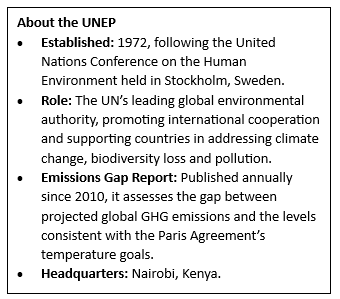
- The report is the 17th edition of UNEP’s annual assessment, published since 2010.
- The report comes at a time when countries across the world are breaching historic temperature records.
- In 2024, the world for the first time recorded a temperature rise above 1.5°C.
- Ahead of COP31, the report calls for urgent emission cuts to minimise temperature overshoot and return warming to 1.5°C by 2100, while extending key climate-action benchmarks to 2035 and 2040.
Key Findings of the Report
- Global GHG emissions: Reached 58.4 GtCO₂e in 2025, marginally lower than in 2024.
- Fossil-fuel emissions: CO₂ emissions from fossil fuels continued to rise despite the slight decline in total GHG emissions.
- Major contributors: G20 members, excluding the African Union, accounted for 76% of global emissions. Their emissions, excluding land use, land-use change and forestry (LULUCF), increased by 0.7% in 2025.
- Uneven national trends: Over the past decade, 63 countries reduced their emissions, while 124 countries recorded increases.
- 1.5°C overshoot pathway: Peak warming could be limited to 1.7–1.8°C around mid-century, followed by a return to or below 1.5°C by 2100, with approximately a 50% chance.
- Required emission cuts: To follow this pathway, global GHG emissions must decline by 18% by 2030, 45% by 2035 and 69% by 2040, relative to 2025 levels.
- NDC gap: Full implementation of current Nationally Determined Contributions (NDCs) would reduce emissions by only 5–8% by 2030 and 11–15% by 2035.
- Future warming: Global warming could reach 2.8°C under current policies, 2.6°C with full implementation of NDCs and around 2.1°C if NDCs and additional net-zero pledges are achieved.
- Carbon dioxide removal: Returning to 1.5°C would require removing and permanently storing approximately 320 Gt of CO₂ over this century.
Key Recommendations
- Accelerate emission cuts: Implement immediate, deep and sustained GHG reductions instead of relying on existing climate pledges.
- Scale up clean energy: Advance the GST goals of tripling renewable energy capacity and doubling the annual rate of energy-efficiency improvements by 2030.
- Reduce fossil-fuel dependence: Accelerate the transition away from fossil fuels and cut emissions from energy systems and road transport.
- Cut methane emissions: Reduce methane emissions by at least 25% by 2035 and 40% by 2040, relative to 2025 levels.
- Protect forests: Accelerate efforts to halt and reverse deforestation and forest degradation by 2030.
- Expand carbon removal: Develop sustainable carbon dioxide removal and permanent storage capacity alongside deep emission reductions.