
SYLLABUS
GS-3: Infrastructure: Energy, Ports, Roads, Airports, Railways, etc.
Context: Recently, a panel under the Ministry of Environment has approved the 260-megawatt Dulhasti Stage-II hydropower project on the Chenab River in Kishtwar, Jammu & Kashmir.
More on the News
- The Expert Appraisal Committee on hydel projects under the Union Environment Ministry granted environmental clearance during the committee’s 45th meeting to the 260 MW (2*130 MW) Dulhasti Stage-II hydropower project.
- The project will be developed by NHPC Limited at an estimated cost of about ₹3,277 crore.
- The clearance enables the government to proceed with floating construction tenders for the project.
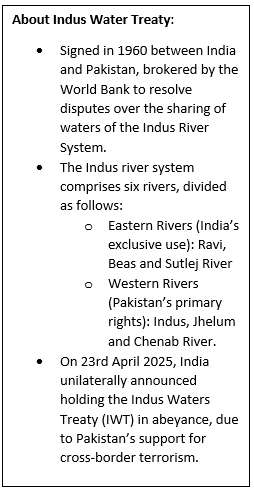
- The project parameters were originally designed in line with the Indus Waters Treaty, 1960 provisions governing the Chenab basin.
- The Centre is expediting several hydropower projects in the Indus basin, including Ratle, Sawalkote, Bursar, Pakal Dul, Kwar, Kiru and Kirthai projects.
Overview of the Dulhasti Stage-II Hydel Power Project
- Dulhasti Stage-II is a run-of-the-river hydropower project with an installed capacity of 260 MW (2*130 MW).
- It is an extension of the existing 390 MW Dulhasti Stage-I Hydroelectric Project.
- Dulhasti Stage-I was commissioned in 2007 and has been operating successfully under NHPC Limited.
- Stage-II will utilise the existing dam, reservoir and power intake infrastructure of Stage-I.
- Water will be diverted through a separate tunnel of about 3.7 km length to create pondage for Stage-II.
- The project includes a surge shaft, pressure shaft and an underground powerhouse.
- Water for the project will be sourced from the Marusudar River through the Pakal Dul project linkage.
- The Chenab basin already hosts operational projects such as Dulhasti-I, Baglihar and Salal.
- Additional projects on the Chenab are under construction, making the basin a major hydropower hub.
- Dulhasti Stage-II is expected to strengthen regional power supply and support India’s strategic and energy security objectives in the Indus basin.
Significance of the Project
- Assertion of Water Sovereignty: By advancing construction while the treaty is in “abeyance,” India is signalling a shift toward full utilisation of its Himalayan rivers. This serves as a strategic maneuver to use water rights as leverage in regional security and diplomatic relations.
- Infrastructure Optimisation: The project is highly cost-efficient because it utilises the existing dam and reservoir of Dulhasti Stage-I. This “brownfield” approach allows for a significant increase in power generation capacity (from 390 MW to 650 MW total) with a relatively small environmental footprint.
- Energy Security for Jammu & Kashmir: The project is a critical component of India’s plan to make the region a hydropower hub. It aims to address chronic power shortages and stimulate local industrial growth through a reliable supply of renewable energy.
- Strategic Fast-Tracking: The rapid clearance by the Expert Appraisal Committee—shortly after the 1,856 MW Sawalkote project—demonstrates a coordinated effort to create “facts on the ground.” This establishes a physical presence on the Chenab river that would be difficult to reverse in future treaty negotiations.
Source:
Thehindu
Indianexpress