
SYLLABUS
GS-2: Government Policies and Interventions for Development in various sectors and Issues arising out of their Design and Implementation.
Context: The Department of Agriculture and Farmers Welfare (MoA&FW) has prepared the draft legislation to replace the existing Insecticides Act of 1968 and the Insecticides Rules of 1971, aligning the regulatory framework with present-day requirements.
More on the News:
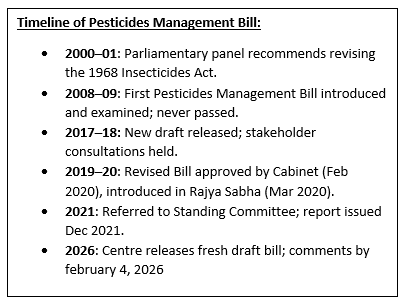
- As part of pre-legislative consultation, the Ministry of Agriculture and Farmers’ Welfare (MoA&FW) has invited feedback from all stakeholders by February 4, 2026, to refine the legislation before it is introduced in Parliament.
- The move comes amid a rise in complaints from farmers about counterfeit and spurious pesticides and insecticides allegedly being sold in the market, causing significant financial losses.
- In November last year, the Government released the draft Seeds Bill, which is likely to be introduced in this Budget session.
Key Features of the Bill:
- Modernise India’s regulatory framework on pesticides: The Bill recommends granting registration to bona fide applicants with the required and verified manufacturing facilities, ensuring that pesticides are produced without compromising on quality, safety, or efficacy.
- Unified Control: Moving away from fragmented state-centric systems, the bill declares pesticide regulation as a Union subject.
- Two-tier institutional framework:
- Central Pesticides Board — advisory body for scientific and technical policy.
- Registration Committee — executive body responsible for granting, reviewing, suspending, or cancelling pesticide registrations.
- Quality Assurance: Mandatory accreditation of testing laboratories to ensure quality pesticides reach farmers.
- Strengthening enforcement at the local level: Provisions for compounding of offences with enhanced penalties to be defined by State-level authorities.
- Striking a balance: Seeks to balance ease of living for farmers with ease of doing business for industry stakeholders.
- Promoting ease of living: Incorporate provisions such as transparency and traceability to ensure better service to farmers.
- Digital Inclusion: Incorporates digital methods and technology to streamline processes.
- “Farmer-centric” Policy: The draft aims to improve service delivery and access to quality pesticides while maintaining ease of doing business for industry stakeholders.
Issues and Concerns:
- There is concern in the plant-protection industry over inspector- and licence-driven regimes hindering research on new molecules in the absence of adequate regulatory data protection.
- The draft does not mention pricing, leaving it to the companies concerned to determine the cost price.
- The Bill should decriminalise minor procedural violations like labelling or documentation errors and address them through monetary penalties or administrative sanctions, reserving criminal punishment only for serious offences such as manufacturing or selling unregistered, counterfeit, or adulterated pesticides.
- In the present draft, regulatory data protection is missing, which discourages the industry from investing in new molecules which are off patent.
- The draft (2008) recognised the necessity of regulatory data protection for five years.