
SYLLABUS
GS-1: Indian culture will cover the salient aspects of Art Forms, literature and Architecture from ancient to modern times.
Context: Recently, Pakistani archaeologists uncovered rare coins and decorative stone artefacts during systematic excavations at a UNESCO-recognised site near Takshashila.
More on the News
- This discovery provides important insights into the early urban settlement of an extensive ancient civilisation.
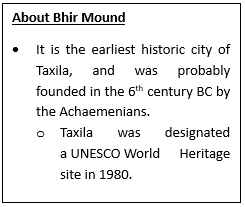
- The findings were recorded at the ancient Bhir Mound, where archaeologists uncovered decorative stone artefacts dating to the 6th century BC and coins from the 2nd century AD.
Key Findings of the Discovery
• Decorative stone: Decorative fragments made of lapis lazuli and other semi-precious stones were found.
• Rare Bronze Coins: The coins bear the image of Emperor Vasudeva, who is recognised by historians as the last of the “great Kushan rulers” to govern the region.
- The obverse of the recovered coinage depicts Vasudeva, while the reverse features a female religious deity.

Significance of the Discovery
• Reaffirm Kushan dynasty’s Influence: These recent discoveries confirm that Takshashila attained the zenith of its political, cultural, and economic prominence during the Kushan period, particularly between the 1st and 3rd centuries AD.
- The period also marked the rise of Gandharan art, a distinctive synthesis of Greek, Roman, Persian, and Indian traditions, with Takshashila serving as its core hub.
• Insights into Ancient Civilisations: Kushan coins serve as some of the most critical historical sources for understanding ancient South and Central Asia.
• Evidence of Long-Distance Trade: The discovery of the deep-blue lapis lazuli fragments provides vital clues regarding ancient supply chains.
- The presence of stones at Taxila points to long-distance trade links, particularly with Badakhshan in present-day Afghanistan.
About the Kushan Empire
- The Kushan Empire was founded in the 1st century AD by Kujula Kadphises, who united the Yuezhi tribes in Central Asia.
- The empire reached its peak as a major administrative, commercial, and intellectual centre under Kanishka in the 2nd century AD, controlling large parts of Central Asia and northern India.
- It existed for roughly 200-250 years, leaving a lasting impact on trade, art, and culture in the region.
- The Empire declined around 300 AD, with its territories gradually absorbed by rising regional powers like the Gupta Empire.