
SYLLABUS
GS-2: Statutory, regulatory and various quasi-judicial bodies.
Context: Despite the 2019 amendment to promote institutional arbitration, the Union Government has not constituted the Arbitration Council of India, delaying arbitration reforms and India’s global ambitions.
Key highlights of the Development
• The Arbitration Council of India (ACI) is a statutory body established under Part IA (Sections 43A to 43M) of the Arbitration and Conciliation Act, 1996, as amended in 2019, to promote and regulate institutional arbitration and ADR mechanisms in India.
• Despite its design to grade arbitral institutions, accredit arbitrators, and reduce judicial intervention, ACI remains non-functional as of January 2026, with no chairperson or members appointed by the Central Government.
• Reason for delay given by the Union Law Ministry:
- Institutional arbitration taking time to gain acceptance among corporates and public sector undertakings.
- Difficulty in regulation, as institutional arbitration has not fully developed in India.
- Dominance of ad hoc arbitration has created inefficiencies and uncertainty in dispute resolution.
- Many government departments are increasingly opting for mediation instead of arbitration.
• According to the Union Law Ministry, institutional arbitration has now begun to take shape, and the council is expected to be constituted within the year.
• In February last year, an expert committee chaired by former Law Secretary T K Vishwanathan submitted a report on arbitration reforms to the Law Ministry.
- The committee recommended giving courts the power to set aside or vary arbitral awards.
• Industry stakeholders criticised the proposed changes, viewing them as a setback to arbitration reforms.
• A draft Bill to amend arbitration laws was floated in October last year, but further action has remained stalled.
Arbitration Council of India (ACI)
• The Arbitration Council of India (ACI) is an independent statutory body introduced by the Arbitration and Conciliation (Amendment) Act, 2019.
• The ACI was established to transform India into a global hub for arbitration and to institutionalise the process.
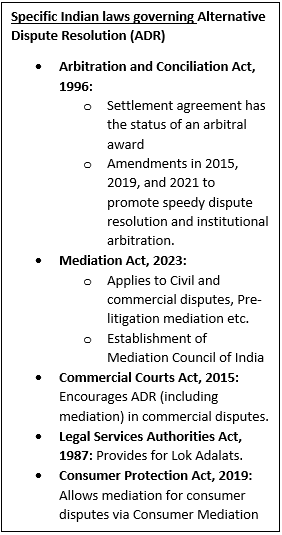
Promoting ADR: Encouraging the use of arbitration, mediation, and conciliation for commercial dispute resolution.
- Arbitration: Binding dispute resolution by a neutral arbitrator outside courts.
- Mediation: Voluntary facilitation of settlement by a neutral third party.
- Conciliation: Assisted negotiation where a conciliator proposes settlement terms.
Standardisation: Establishing uniform professional standards for all ADR matters.
• The Council is structured to include judicial, professional, and government representatives:
- Chairperson: A former Supreme Court Judge, a former Chief Justice of a High Court, or an eminent arbitration expert.
- Full-time Members: Eminent arbitration practitioners and academicians specialised in ADR.
- Ex-officio Members: Including the Secretary to the Department of Legal Affairs and the Secretary to the Department of Expenditure.
- Part-time Member: One representative from a recognised body of commerce and industry.