
SYLLABUS
GS-3: Conservation, environmental pollution and degradation, environmental impact assessment
Context: Recently, the Supreme Court of India has accepted the Centre’s uniform, elevation-based definition of the Aravali Hills and Ranges.
About the Judgement
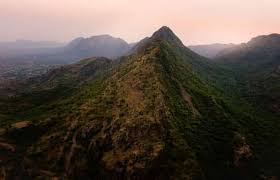
- The landmark ruling aims to protect the Aravali Hills—the world’s oldest mountain range—spanning Delhi, Haryana, Rajasthan, and Gujarat, and to prevent further environmental degradation caused by illegal and unsustainable mining activities.
• Definition of Aravali Hills and Range:
- “Aravali Hill” will be defined as any landform in designated Aravali districts with an elevation of 100 metres or more above its local relief and an “Aravali Range” will be a collection of two or more such hills within 500 metres of each other.
- Entire landform within the lowest contour line enclosing the hill, including supporting slopes and associated landforms, constitute part of Aravali Hills.
- The area between two Aravali hills is determined by buffers equal to the minimum distance between their lowest contour lines.
• Ban on Fresh Mining Leases:
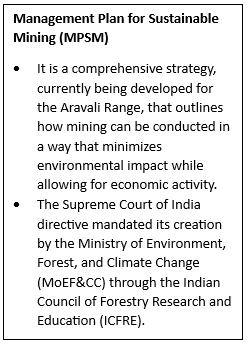
- No fresh mining leases are to be granted in the Aravali region until the Management Plan for Sustainable Mining (MPSM) is finalized.
- Existing mining activities can continue but must comply strictly with committee recommendations and environmental safeguards.
- Mining is prohibited in core and inviolate areas, except in exceptional, scientifically justified cases.
Significance of the Judgement
- This judgment reinforces the role of the judiciary in environmental conservation, particularly for fragile ecosystems like the Aravali Hills.
- The ruling balances environmental conservation with developmental needs by allowing sustainable mining only under strict, expert-guided conditions.
- The decision emphasizes the Aravallis’ role as a “green barrier” protecting fertile plains from desert expansion and dust storms, reinforcing the need for its ecological preservation.
Challenges associated with the Judgement
- 100 m rule excludes most of the Aravali Hills: Forest Survey of India data shows only 8.7% of the 12,081 hills meet this cutoff, meaning over 90% of the Aravallis lose protection and become vulnerable to mining, construction, and development.
- Undermining Ecological role of Low hills: Losing protection for the smaller hills breaks the ecological continuity, risking increased air pollution, groundwater depletion, habitat loss, and human-wildlife conflicts.
- Impact Delhi-NCR Air Quality: Since the Aravallis act as a barrier against desert dust migration towards Delhi NCR and neighboring states, limiting protected areas may worsen air quality and dust storm problems.
Aravali Range
- The Aravali Range is one of the oldest mountain ranges in India and the world, dating back to the Paleoproterozoic era.
- It stretches approximately 670 to 692 kilometers, running in a southwest to northeast direction.
- The range begins near Delhi and passes through Haryana, Rajasthan, and ends in Gujarat.
- It is about 10 to 120 kilometers wide, with elevations generally between 300 and 900 meters.
- The highest peak is Guru Shikhar in Mount Abu, Rajasthan, at 1,722 meters.
- The Aravali acts as a natural barrier separating the Thar Desert from the fertile plains of eastern Rajasthan and beyond.
- About 80% of the range lies in Rajasthan, with the rest in Haryana, Delhi, and Gujarat.
Sources:
The Hindu
Scobserver