
SYLLABUS
GS 1: Indian culture.
GS 2:Important International institutions.
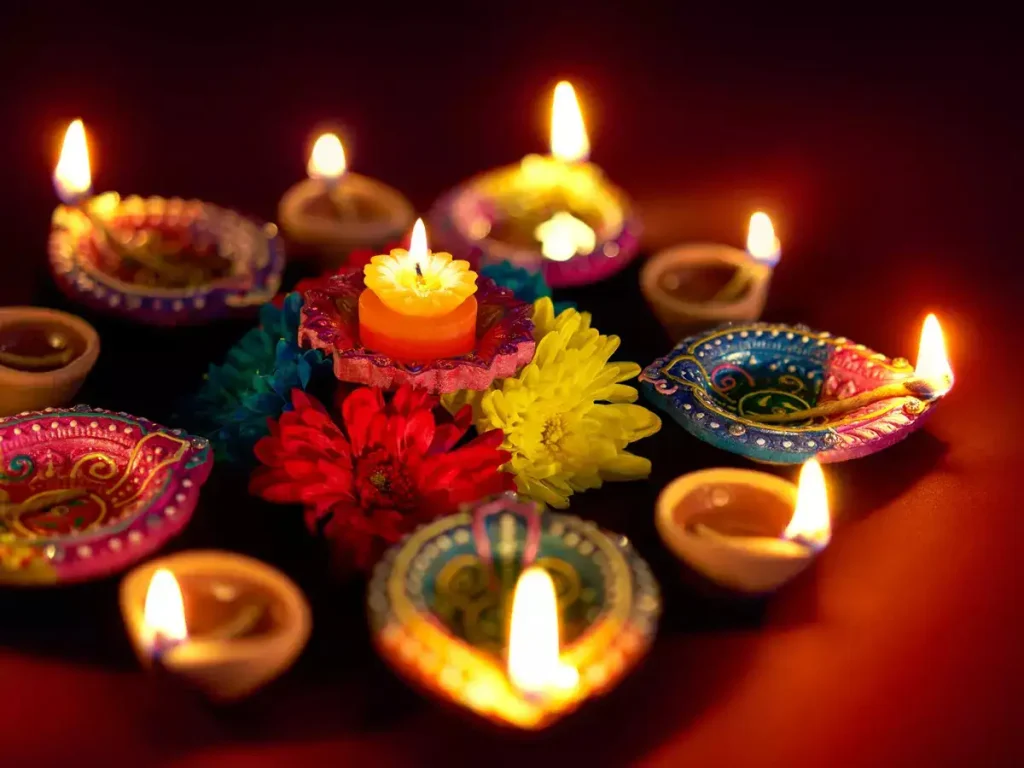
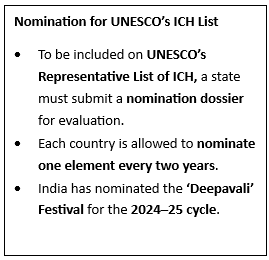
Context: Deepavali, the festival of lights, has been inscribed on UNESCO’s List of the Intangible Cultural Heritage of Humanity, announced at the 20th UNESCO Intergovernmental Committee session at New Delhi’s Red Fort from December 8-13, 2025.
More on the News
- The inscription was adopted in the presence of delegates from 194 Member States, international experts, and representatives of UNESCO’s global network.
- Deepavali Festival is the 16th Indian element on this list.
- Deepavali, also known as Diwali, is celebrated on Kartik Amaavasya, which typically falls in October or November.
- It is a five-day festival, starting with Dhanteras, Narak Chaturdashi (Choti Diwali), the main Diwali (Lakshmi Puja), Govardhan Puja, and Bhai Dooj celebrations.
- It marks the return of Lord Rama, who was the seventh incarnation of Vishnu, from a fourteen-year exile.
- Lord Mahavira, the 24th Tirthankar, attained Nirvana on Deepavali at Pavapuri.
- The inscription of Deepavali on the UNESCO Intangible Cultural Heritage List is a tribute to the millions who celebrate it with devotion, to the artisans who keep its traditions alive, and to the timeless principles it represents.
About Intangible Cultural Heritage
- It was adopted on October 17, 2003, during UNESCO’s 32nd General Conference in Paris, France.
- The Convention responded to global concerns over cultural traditions, performing arts, rituals, craftsmanship, and knowledge systems being threatened by globalisation, social change, and limited resources.
- It emphasises the role of communities, indigenous groups, and individual practitioners in safeguarding heritage, while promoting global cooperation and awareness among younger generations.
- China has the highest number of elements on UNESCO’s Representative List of the Intangible Cultural Heritage of Humanity (44), followed by Türkiye with 31 elements and France with 30.