
SYLABUS
GS-3: Awareness in the fields of IT, Space, Computers, Robotics; Security Challenges and their Management in Border Areas.
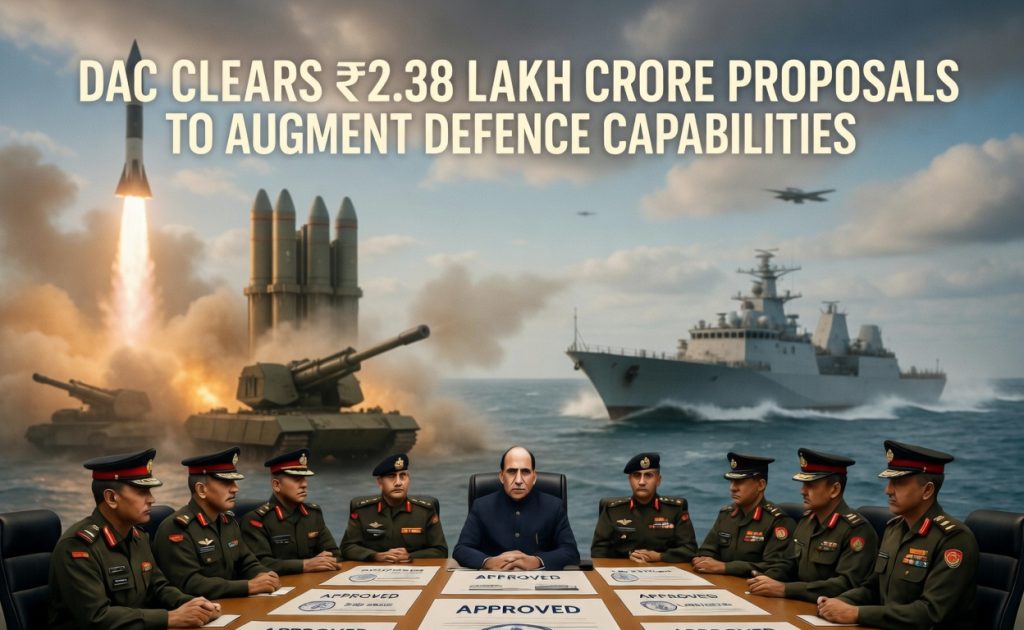
Context: Recently, the Defence Acquisition Council (DAC), chaired by the Defence Minister, approved several capital acquisition proposals to augment the capabilities of the defence forces.
More on the News
• The DAC granted Acceptance of Necessity (AoN), which is the first stage in India’s defence procurement process, for proposals worth approximately ₹2.38 lakh crore.
• The approvals span across the Indian Army, Indian Air Force, and Indian Coast Guard, reflecting a comprehensive and integrated approach to capability enhancement.
• These approvals aim to significantly enhance India’s combat readiness, surveillance capability, mobility, and communication infrastructure across the armed forces.
• The approvals come at a time of evolving security challenges, including multi-domain warfare, border tensions, and emerging technological threats.
• Alongside the large-scale AoN approvals, the Ministry of Defence has also signed contracts worth ₹858 crore for the procurement of Tunguska air defence systems for the Army and maintenance support for the Navy’s P-8I reconnaissance fleet.
Key Highlights of the Various Systems/Weapons
Indian Army
• Air Defence Tracked System: Mobile C4I platform for real-time air defence control/reporting, integrating radars/sensors across battlefields.
• Armoured Piercing Tank Ammunition: Next-gen anti-tank rounds to defeat modern MBTs with composite/reactive armour.
• Dhanush Gun System: 155mm/45 calibre howitzer (indigenous), 38–40 km range, all-terrain mobility, precision-guided munitions.
• High-Capacity Radio Relay: Secure battlefield communications with high throughput, jam-resistant links for tactical networks.
• Runway Independent Aerial Surveillance: VTOL UAVs for persistent ISR in forward areas without airfields.
Indian Air Force
• S-400 Long Range SAM (5 additional squadrons): 400 km range, multi-target engagement vs aircraft, cruise missiles, AWACS.
• Medium Transport Aircraft (MTA): Strategic/tactical airlifters (250–300 tonnes capacity) to replace ageing An-32/Il-76 fleets.
• Remotely Piloted Strike Aircraft: DRDO UCAVs for precision strikes, stealth ISR, deep penetration missions (7–8 year timeline).
• Su-30 MKI Aero-engine Overhaul: Life extension for 272 fighters, reducing foreign dependency.
Indian Coast Guard
• Heavy Duty Air Cushion Vehicles (ACVs): Amphibious hovercrafts for high-speed coastal ops, SAR, logistics in shallow waters.
Significance of the Move
• Strengthening Multi-Layered Defence: The procurement of advanced systems such as long-range air defence missiles and surveillance platforms enhances India’s multi-layered defence architecture against aerial and ground threats.
• Boost to Operational Preparedness: The upgrades across services improve readiness for both conventional and asymmetric warfare, including counter-drone operations and network-centric warfare.
• Modernisation of Armed Forces: Replacement of ageing platforms and induction of new technologies contribute to the ongoing modernisation of India’s armed forces, aligning them with global standards.
• Strategic Deterrence: Advanced weapon systems and surveillance capabilities strengthen India’s deterrence posture in a volatile regional security environment.
• Promotion of Aatmanirbhar Bharat: Increased focus on indigenous procurement, maintenance, and repair capabilities supports the government’s push for self-reliance in defence manufacturing and reduced import dependence.
About the Defence Acquisition Council (DAC)
• The Defence Acquisition Council is the highest decision-making body in India for defence procurement.
• It is chaired by the Defence Minister and includes senior officials from the armed forces and the Defence Ministry.
• The DAC is responsible for granting Acceptance of Necessity (AoN) for capital acquisitions, which marks the formal beginning of the procurement process.
• It plays a crucial role in ensuring that procurement aligns with strategic requirements, budgetary constraints, and indigenisation goals.
SOURCES
PIB
Indian Express