
SYLLABUS
GS-1: Salient features of world’s physical geography
GS-1: Important Geophysical phenomena such as earthquakes, Tsunami, Volcanic activity, cyclone etc., geographical features and their location- changes in critical geographical features (including water bodies and ice-caps) and in flora and fauna and the effects of such changes.
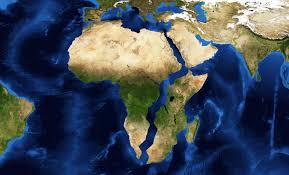
Context: According to the researchers, Africa is undergoing a dramatic geological transformation that could eventually divide the continent into two separate landmasses.
More on the News
- New magnetic data shows the African crust is slowly but steadily splitting apart, a process that could eventually form a new ocean.
- The ongoing separation is progressing from the northeast to the south in a motion scientists liken to “the zip on a jacket”, tearing through the continent alongside intense volcanic and seismic activity.
- According to current geological timelines, the complete split is expected to occur within the next five to ten million years.
Underlying Causes
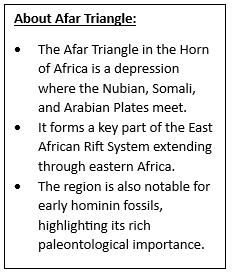
- Active Afar Triple Junction: The Afar region, where three major rifts meet, serves as the central point of Africa’s ongoing continental breakup.
- Drifting Tectonic Plates: Africa is being slowly pulled apart along the boundary between the Somalian and Nubian Plates, while the Arabian Plate continues drifting away.
- The East African Rift System, stretching from the Middle East to Mozambique, shows clear signs of crustal thinning and stretching.
- Geological Heartbeat: New research reveals rhythmic pulses of molten rock rising beneath Afar, weakening the crust and driving the early stages of a future ocean’s formation.
Expected Changes
- When the process finishes, Africa will likely exist as two distinct regions:
- The larger Western landmass would contain major nations, including Egypt, Algeria, Nigeria, Ghana, and Namibia.
- The Eastern landmass would include Somalia, Kenya, Tanzania, Mozambique, and a significant portion of Ethiopia.
- As the split deepens over geological time, it is expected to cut directly through large East African lakes such as Lake Malawi and Lake Turkana.
Significance of the Study
- Dynamic Earth Processes: Plate tectonics shows that continents are constantly shifting and evolving over millions of years, highlighting the dynamic nature of Earth’s crust.
- Geological Risks: Rift zones like East African Rift System and Afar face higher seismic and volcanic activity, making geological understanding important for long-term planning and hazard preparedness.
- Environmental and Evolutionary Impact: Shifting continents and expanding seas reshape ecosystems, climate patterns, and species distribution, influencing biodiversity and evolution.
- Long-Term Geological Change: The potential formation of a new ocean reflects Earth’s ongoing reshaping, similar to past events like the breakup of Gondwana.
Sources:
Indian Express