
SYLLABUS
GS-3: Conservation, Environmental Pollution and Degradation, Environmental Impact Assessment.
Context: A new study published in Communications Earth & Environment reveals that the Sundarbans is increasingly losing its ecological resilience, raising concerns about long-term sustainability.
Key Findings of the Study
- Extent of Declining Resilience: Nearly 10–15% of the Sundarbans has lost its recovery capacity, with the northern and coastal boundaries showing the sharpest decline, and India’s western part found to be less resilient than Bangladesh’s eastern region.
- Impact of Extreme Events: Major cyclones such as Sidr, Rashmi, and Aila (2007–09) triggered significant ecological shifts, pushing large forest areas (~800–1,100 sq km per event) from highly resilient to moderately resilient categories.
- Emergence of Ecological Instability: The study highlights “critical slowing down”, where ecosystems take longer to recover from disturbances, indicating rising instability and proximity to ecological tipping points.
- Shifting Vulnerability Zones: A new vulnerability hotspot has emerged in the north-eastern Sundarbans, while central and coastal zones continue to face repeated disturbances that weaken resilience.
- Biodiversity and Carbon Loss: Stress on dominant species like Sundari (Heritiera fomes) due to diseases has reduced species diversity and altered forest structure, with some areas shifting from carbon sinks to carbon sources, leading to measurable ecological and economic losses.
Causes of Declining Resilience
- Climate Change Stressors: Rising temperatures, sea-level rise, and salinity intrusion are altering mangrove physiology, forcing trees to divert energy from growth to survival, thereby reducing regeneration capacity.
- Cyclones and Extreme Events: Frequent high-intensity cyclones damage canopy cover and root systems, causing repeated disturbances that slow ecosystem recovery and push forests into lower resilience states.
- Hydrological Alterations: Upstream dams and altered freshwater flows reduce sediment and freshwater input, increasing salinity and disrupting the natural hydrological balance of the delta.
- Anthropogenic Degradation: Activities such as shrimp farming, encroachment, illegal logging, and nutrient pollution (e.g., excess phosphorus) degrade forest structure, create anoxic soil conditions, and weaken overall ecosystem stability.
About Sundarbans
- The Sundarbans is the world’s largest contiguous mangrove forest, located in the Ganga-Brahmaputra-Meghna delta.
- It spans over 10,000 sq km across India and Bangladesh and is recognised as a UNESCO World Heritage Site for its ecological significance.
- In January 2019, the Indian Sundarban was accorded the status of ‘Wetland of International Importance’ under the Ramsar Convention.
- It was the 27th Ramsar Site in India, and with an area of over 4200 sq. km., it is the largest protected wetland in the country.
- The Bangladesh part of the Sunderbans (area of over 6000 sq. km.) had received the Ramsar tag way back in 1992.
- The Indian Sundarban, covering the south-westernmost part of the delta, constitutes around 43% of the country’s total mangrove forest area and includes about 90% of Indian mangrove species.
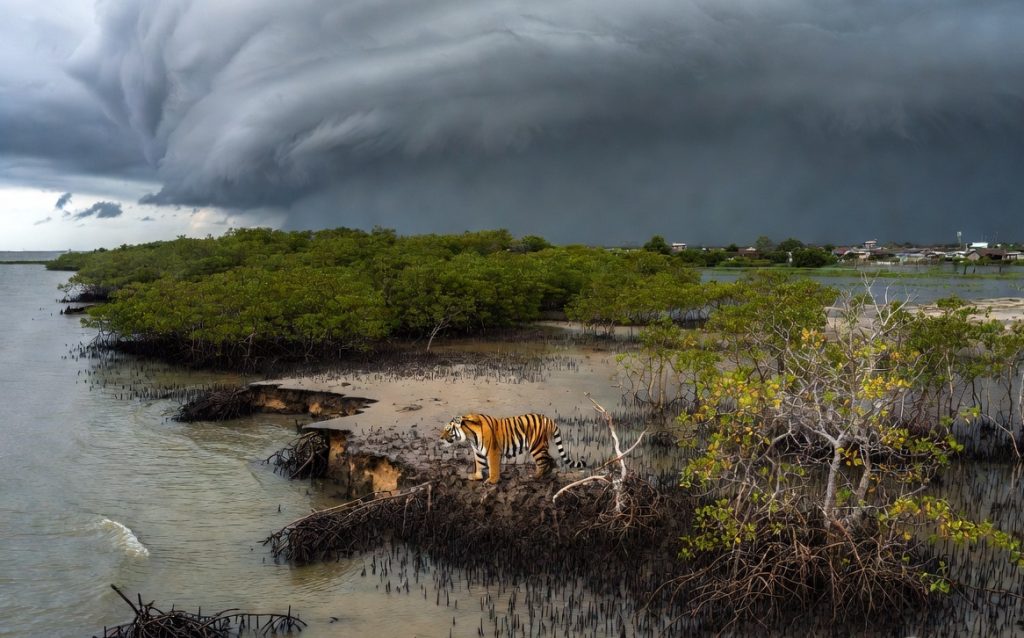
- The Indian Sundarban is also home to a large number of rare and globally threatened species, such as the critically endangered northern river terrapin (Batagur baska), the endangered Irrawaddy dolphin (Orcaella brevirostris), the endangered Bengal tiger (Panthera tigris tigris), and the vulnerable fishing cat (Prionailurus viverrinus).
Significance of Sundarbans
- Ecological Importance: The Sundarbans is a global biodiversity hotspot, supporting diverse flora and fauna and maintaining ecological balance.
- Climate Regulation: Mangroves act as significant carbon sinks (blue carbon ecosystems), playing a crucial role in mitigating climate change.
- Disaster Protection: The ecosystem acts as a natural buffer against cyclones, storm surges, and coastal erosion, protecting millions of people.
- Livelihood Support: It sustains millions of people through fisheries, forestry, and agriculture, forming the backbone of local economies.