
SYLLABUS
GS-3: Conservation, Environmental Pollution and Degradation; Disaster and Disaster Management.
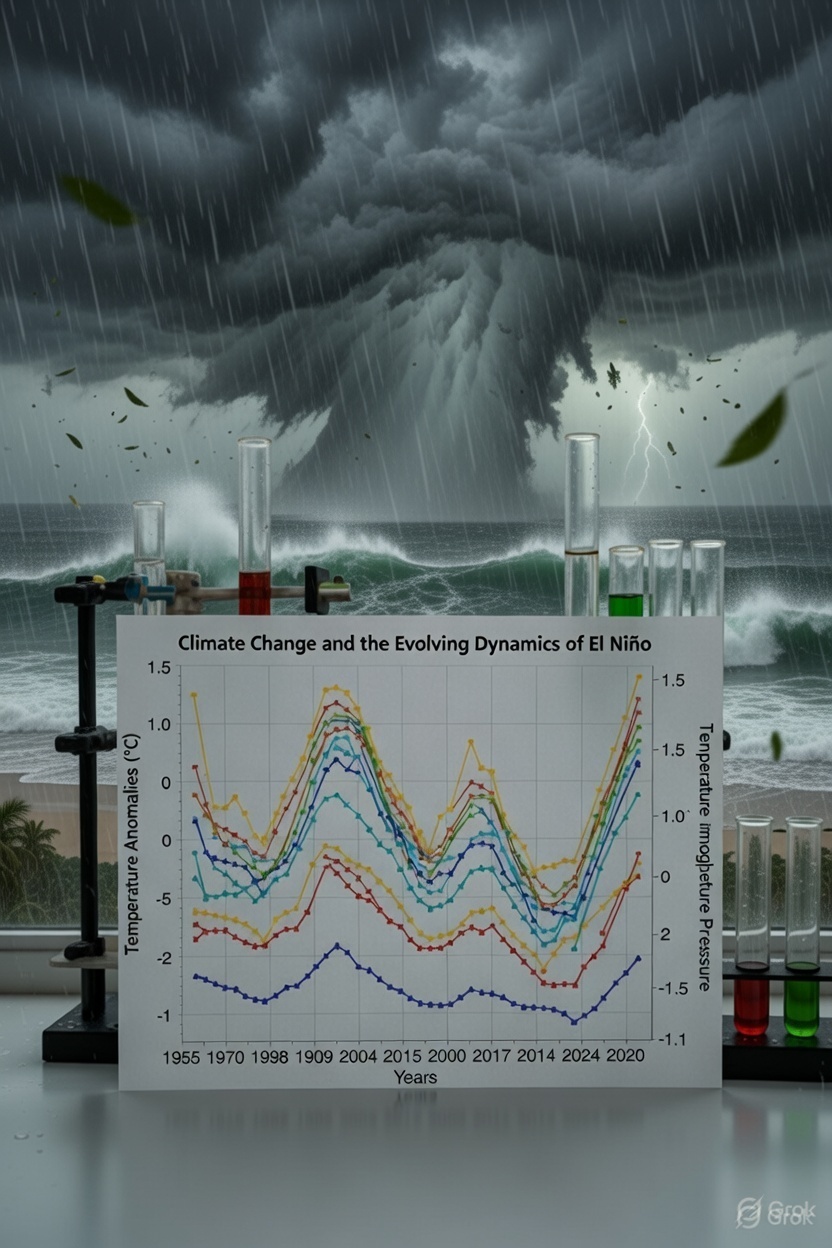
Context: A recent scientific study has indicated that an unusual shift in the El Niño–La Niña cycle may help explain the sharp spike in global temperatures observed over the past three years, beyond the ongoing long-term warming trend.
More on the News
- Over the past three years, global temperatures have surged beyond the long-term warming trend, prompting researchers to examine the role of ENSO cycles in amplifying this spike.
- A recent study published in Nature Geoscience linked the sharp global temperature increase since 2023 to a combination of long-term greenhouse gas warming and a transition from a prolonged La Niña phase to El Niño.
- Researchers observed a rise in Earth’s Energy Imbalance (EEI)—the difference between incoming solar radiation and outgoing heat—which contributes to temperature rise.
- The study estimates that roughly three-quarters of the recent change in energy imbalance stems from the combined effect of long-term greenhouse‑gas warming and the switch from a three-year La Niña to a warm El Niño phase.
- Simultaneously, rapid ocean warming has forced agencies like the U.S. National Oceanic and Atmospheric Administration (NOAA) to revise how they define and label El Niño and La Niña.
Classification of El Niño and La Niña
- Traditionally, El Niño and La Niña were classified by comparing sea‑surface temperatures (SSTs) in specific tropical Pacific regions with a fixed 30‑year “normal”.
- An El Niño event was declared when SSTs were at least 0.5°C above the long-term average, while La Niña was defined by a similar cooling threshold.
- In a rapidly warming world, what qualifies as “normal” has shifted upward, making earlier thresholds less reliable.
- This has led the NOAA to now use a revised index which compares eastern Pacific SSTs to the broader tropical oceans.
- Under this updated, more dynamic approach, events are defined more by how the Pacific differs from the rest of the tropics and how strongly the atmosphere responds, rather than just crossing a static temperature threshold.
- This recalibration may lead to more La Niña events being identified and fewer El Niño classifications under the updated methodology.
Scientific Reasons Behind the Change
- ENSO in a Warmer Background Climate: Greenhouse gas–driven ocean warming has raised the baseline temperature, meaning El Niño and La Niña now unfold in an already heated system, amplifying their climatic impacts.
- Prolonged Heat Storage and Sudden Release: The recent “triple-dip” La Niña trapped excess heat within the ocean. The subsequent shift to El Niño released this stored heat into the atmosphere, intensifying global temperature spikes.
- Altered Ocean–Atmosphere Interactions: Climate change is influencing trade winds, Walker circulation, and vertical temperature gradients, thereby modifying the intensity and spatial expression of ENSO events.
- Energy Imbalance Amplification: As Earth absorbs more energy than it emits, ENSO transitions redistribute this trapped heat more dramatically, making phase shifts climatically more significant.
- Redefining ‘Normal’ Conditions: With rising sea surface temperatures, historical baselines are no longer stationary, prompting scientific revisions to ENSO classification methods to better reflect real atmospheric impacts
About El Niño and La Niña
- ENSO is a naturally occurring climate oscillation involving periodic warming (El Niño) and cooling (La Niña) of the central and eastern tropical Pacific Ocean.
- Normal Conditions: Trade winds blow westward along the equator, pushing warm water toward the western Pacific, while cold nutrient-rich water rises near the Americas (upwelling).
- El Niño Phase: Trade winds weaken; warm surface waters spread eastward across the central and eastern equatorial Pacific, reducing upwelling of cold water and altering global circulation.
- La Niña Phase: Trade winds strengthen; warm water piles further west, and stronger upwelling in the east leads to cooler‑than‑average SSTs there, enhancing the normal east–west contrast.
- ENSO events typically occur every 2–7 years and last about 9–12 months, but there is no fixed schedule.