
SYLLABUS
GS-3: Science and Technology- Developments and their Applications and Effects in Everyday Life.
Context: Chinese Nuclear physicists have exceeded a long-standing theoretical density limit at an experimental fusion reactor in China, suggesting that future power plants could generate more energy than previously thought.
More on the news:
- The EAST team, which included more than 18 researchers from Huazhong University of Science and Technology, the Chinese Academy of Sciences and Aix-Marseille Université in France, used electron cyclotron resonance heating and ohmic startup to achieve “plasma-wall self organisation”. This allowed them to access a “density-free regime” without triggering plasma instability.
- The EAST experiment validates a 2017 theoretical study by physicists in France that first challenged the Greenwald limit.
Key highlights of the Experiment:
- Surmounted an important obstacle: Scientists at a nuclear fusion reactor in China pushed plasma density 65% beyond a special threshold, entering a stable state that overcomes a long-standing barrier to achieving burning plasma, the stage where a fusion reaction becomes self-sustaining.
- Exceeded Greenwald density limit: The Experimental Advanced Superconducting Tokamak (EAST) team had achieved stable plasmas at densities 1.3x to 1.65x of the limit. The team achieved this by combining two techniques:-
- First, they used electron cyclotron resonance heating (ECRH) during start-up. In ECRH, microwave beams are shot into the plasma, heating electrons to millions of degrees. This happens before ramping up the plasma current, a large electric current that flows through the plasma to heat it and help create the magnetic cage.
- Second, the team started with more deuterium gas in the chamber, then fed hydrogen fuel as the plasma heated up.
- The Greenwald density limit is an empirical upper limit on the maximum plasma density that can be stably confined in a tokamak fusion reactor before it becomes unstable and disrupts.
- Lithium Coating: For the experiments, EAST’s tungsten surfaces were coated with a thin layer of lithium to condition them and reduce impurities.
Significance of the Experiment
- Roadmap for Tokamak feasibility: The findings suggest a practical and scalable pathway for extending density limits in tokamaks and next-generation burning plasma fusion devices.
- Defy Normative Assumptions: The new experiments challenge the assumption that density is constrained by the Greenwald limit, and Fusion researchers must focus on temperature and confinement of time.
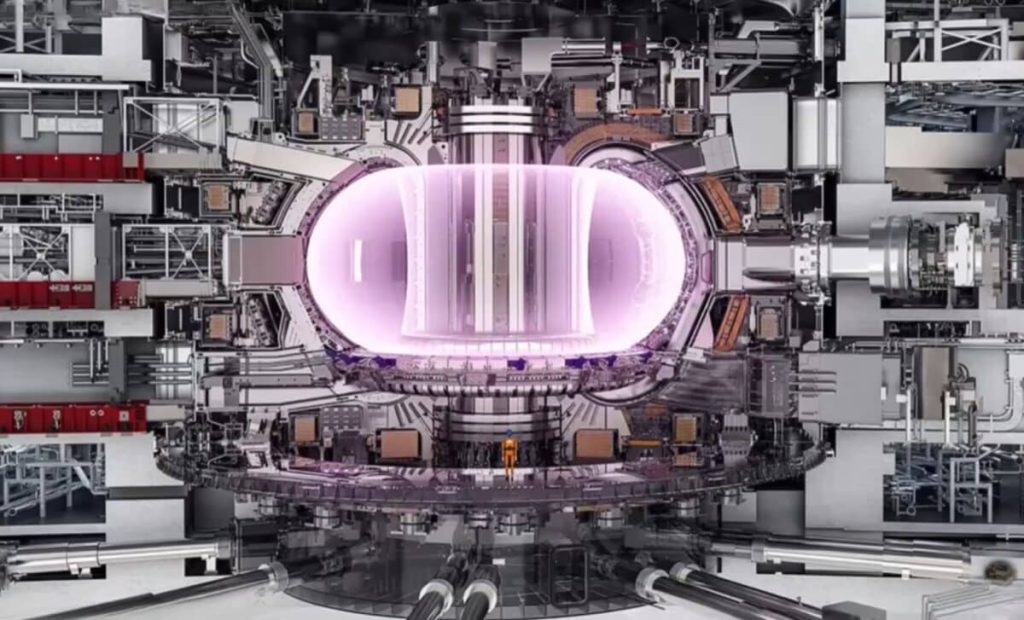
- Relevance to ITER: The Experiment shows that if a reactor can be run at twice the fuel density, it might achieve the conditions for ignition at lower temperatures or with shorter confinement times. This progress complements global efforts of ITER in which India has also invested.
- ITER (International Thermonuclear Experimental Reactor) is the world’s largest international nuclear fusion research project, aimed at demonstrating that fusion energy can be produced safely, sustainably, and at scale.
Other major Nuclear Fusion Tokamaks of the World:
- JT-60SA of Japan: It is World’s largest operational superconducting tokamak.
- DIII-D National Fusion Facility of US: operated by General Atomics for the U.S. Department of Energy, to explore high-performance tokamak discharges as well as fundamental fusion science.
- KSTAR (Korea Superconducting Tokamak Advanced Research) of South Korea: It has achieved 100+ million °C plasma stability, although for very short span.
- ADITYA Tokamak of India: located in the Institute for Plasma Research (IPR), Gandhinagar. It laid the foundation for the SST-1 superconducting tokamak.
- SST-1 (Steady State Superconducting Tokamak-1) is India’s largest indigenously developed superconducting tokamak, designed to study long-duration (steady-state) plasma operations.