SYLLABUS
GS-2: Functions and Responsibilities of the Union and the States, Issues and Challenges Pertaining to the Federal Structure.
GS-3: Infrastructure: Energy.
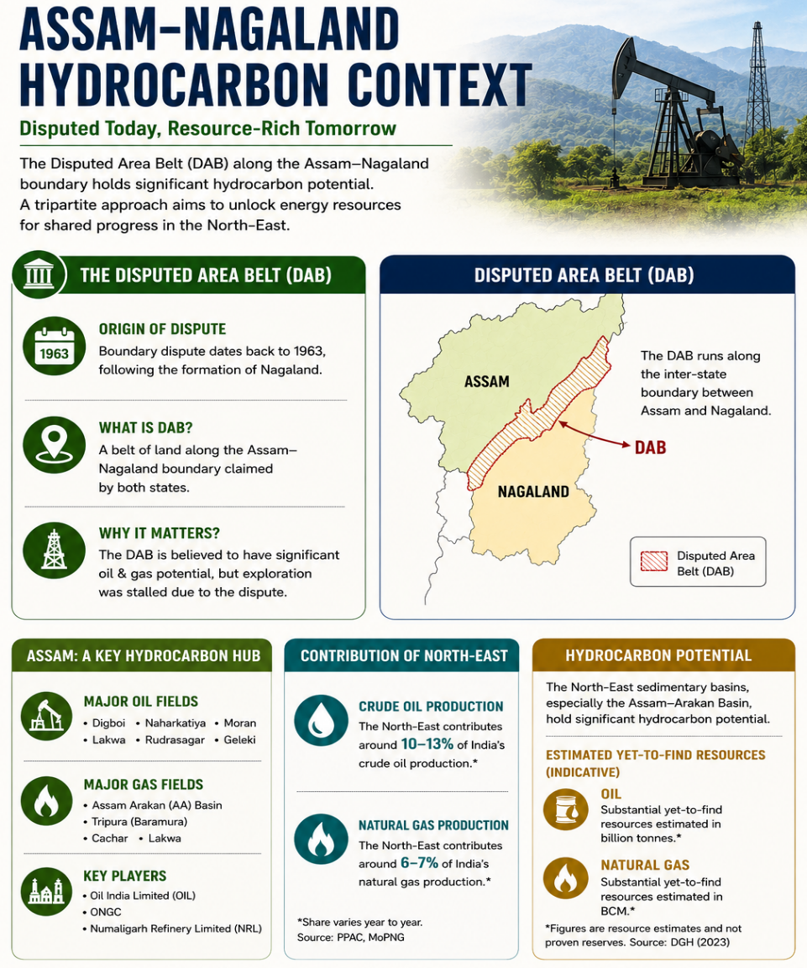
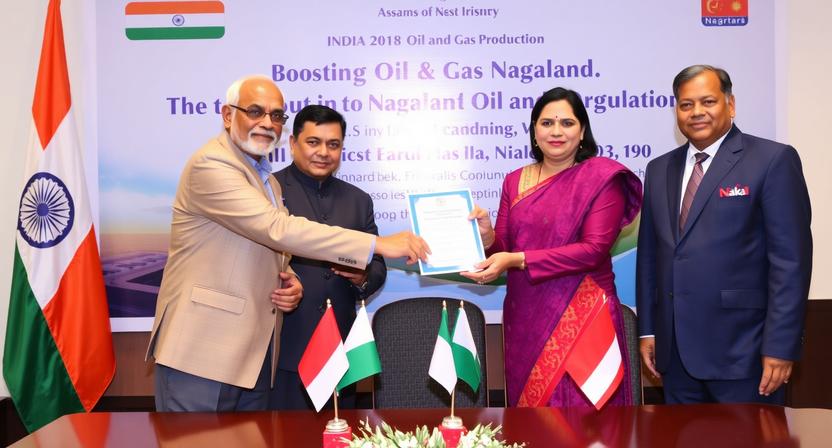
Context: Recently, the Ministry of Petroleum and Natural Gas (MoPNG) signed a Tripartite Memorandum of Understanding (MoU) with the Governments of Assam and Nagaland to facilitate oil and gas exploration and production in hydrocarbon-bearing areas along the inter-state boundary.
More on the News
- The agreement was signed in the presence of the Union Home Minister, Union Minister of Petroleum and Natural Gas, and the Chief Ministers of Assam and Nagaland.
- The agreement seeks to facilitate hydrocarbon exploration and production in areas located within the Disputed Area Belt (DAB) between Assam and Nagaland, where petroleum operations have faced constraints due to jurisdictional and administrative challenges.
- The MoU establishes a mutually agreed framework for exploration and production activities while ensuring that such activities are undertaken without prejudice to the respective claims and positions of the two states on the boundary dispute.
- The Union government, through the Ministry of Petroleum and Natural Gas, will act as a facilitator to promote coordinated development of hydrocarbon resources and create a stable environment for investment and operations.
Key Features of the MoU
- Facilitation of Hydrocarbon Exploration and Production: Provides a framework for coordinated exploration, development and production of oil and natural gas in identified areas of mutual interest.
- Development Without Prejudice to Boundary Claims: Hydrocarbon activities under the MoU will not affect or prejudice the respective territorial claims of Assam and Nagaland.
- Centre as a Facilitator: The Ministry of Petroleum and Natural Gas will facilitate coordination among stakeholders and support smooth implementation of exploration and production activities.
- Stable and Investor-Friendly Environment: The agreement aims to provide greater operational certainty to exploration and production companies, encouraging investment and faster resource development.
- Cooperative Federalism Approach: The MoU represents a collaborative mechanism through which the Union Government and States work together to unlock economic opportunities while managing sensitive inter-state issues.
Significance
- Unlocking North-East’s Hydrocarbon Potential: The agreement can help tap significant untapped reserves of crude oil and natural gas in the hydrocarbon-rich Assam–Nagaland region, which have remained underutilised due to long-standing disputes.
- Strengthening India’s Energy Security: Increased domestic production of oil and natural gas can contribute to reducing import dependence and improving long-term energy security.
- Boost to North-East Development: Greater hydrocarbon exploration is expected to attract investments, generate employment, improve infrastructure and stimulate economic growth in the North-East.
- Model of Cooperative Federalism: The MoU demonstrates how complex inter-state issues can be addressed through dialogue, consensus-building and shared economic interests while respecting constitutional processes.
- Advancing the Vision of a Peaceful and Prosperous North-East: The agreement aligns with the broader vision of promoting peace, stability, connectivity and economic development in the North-East by converting areas of contention into opportunities for cooperation and growth.