
SYLLABUS
GS-1: Role of women and women’s organization, population and associated issues, poverty and developmental issues, urbanization, their problems and their remedies.
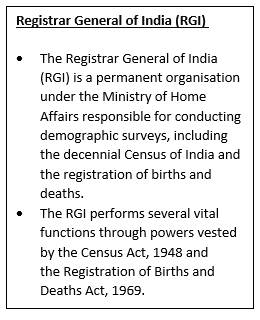
Context: Recently, the Registrar General of India (RGI) has directed all States and Union Territories to complete the appointment and registration of census functionaries by January 15, 2026, to ensure the timely execution of Census 2027.
More on the News
- The circular states that enumerators and supervisors will be the core census functionaries responsible for the upcoming nationwide data collection exercise.
- An enumerator will be assigned a population of about 700 to 800 persons and one supervisor will oversee the work of six enumerators to ensure quality and accuracy.
- According to Rule 3 of the Census Rules (1990), teachers, clerks or any official of a State government and local authority can be appointed as an enumerator, while a supervisor will be an officer generally of a rank higher than that of the enumerator.
- The instructions require States and UTs to appoint 10 percent additional enumerators and supervisors as a reserve to manage any contingencies during field operations.
- The circular highlights that district collectors, district magistrates, or nominated officials will act as principal census officers who will oversee census operations within their jurisdiction.
- In divisions, the divisional commissioners will function as divisional census officers and in municipal corporations, commissioners or civic body heads will serve as principal or additional principal census officers.
- During Census 2027, about 30 lakh field functionaries will be deployed to complete the population count within the prescribed time frame.
- The RGI has developed a web portal — Census Management and Monitoring System (CMMS) for Census 2027 — to manage and monitor all activities like the appointment of enumerators and supervisors, assigning the enumeration blocks and supervisory circles to them and real-time progress of the field work.
Census in India
- The Indian Census is a decennial undertaking conducted by the Office of the Registrar General and Census Commissioner in the Ministry of Home Affairs.
- The last census was conducted in 2011 in two phases. These were Phase I for House Listing and Phase II for Population Enumeration.
- In 1872, India conducted its first non-synchronous census under Lord Mayo, initiating a more organised approach to population enumeration.
- Since 1881, India has followed a ten-year census cycle, with the most recent census conducted in 2011.
- The 1951 census was the first to be carried out after India gained independence.
- The National Population Register (NPR), launched in 2010 and updated in 2015, was designed to build a detailed identity database of all usual residents.
- Due to the COVID-19 pandemic, both the 2021 census and the NPR update were deferred.
Census 2027 Structure
- Census 2027 will be conducted in two phases:
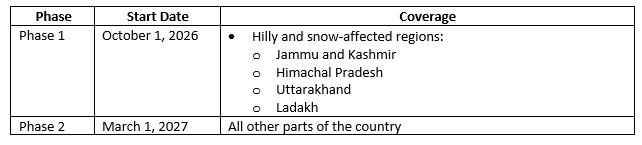
- The Population Enumeration will be carried out in February 2027, with the reference date of midnight of March 1, 2027 for most regions.
- Census 2027 will be a fully digital exercise and will include caste enumeration as approved by the Cabinet Committee on Political Affairs on April 30.
Significance of the Population Census
- Policy Formulation and Planning: Census helps governments design targeted policies in health, education, housing, employment, and welfare.
- Delimitation of Constituencies: Census figures determine the redrawing of Lok Sabha and State Assembly constituencies.
- Social Justice and Inclusion: The inclusion of caste data in Census 2027 will help in identifying socio-economic disparities.
- Benchmark for Other Surveys: It can act as the foundation for all demographic, economic, and social surveys