It is India’s first large-scale comprehensive carbon credit calibration mechanism to increase farmers’ earnings.
More on the News:
This programme will start as a pilot project in the Saharanpur division and gradually be implemented in the rest of the state.
This mechanism is also the country’s first government-academia model that will link improved soil health with higher earnings for farmers.
Key Features of the Model:
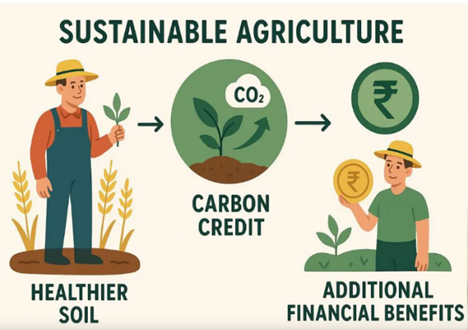
Carbon Credit Mechanism: Farmers will earn carbon credits for reducing carbon emissions because trees planted by them on their land absorb carbon dioxide from the atmosphere continuously for photosynthesis.
One metric tonne of carbon dioxide stored in trees will earn them one carbon credit, which is monetized and farmers will be paid accordingly.
Once sold in the market, 50% of the revenue generated will go to the farmers as direct income in their bank accounts.
Implementing Agency: IIT Roorkee will monitor the pilot programme through remote sensing.
It will enable connections between farmers, carbon markets, and global buyers.
Digital monitoring, reporting, and Verification (D-MRV) systems: It will be used to provide high-quality carbon credits aligned with global standards.
Sustainable practices such as minimum tillage, covered cropping, residue management, agroforestry, and improved bio-fertiliser use, will be scientifically measured and converted into verified carbon credits with the help of this system.
Significance: This model will reduce greenhouse gas emissions, enhance soil quality, promote sustainable agricultural practices, lower farm input costs, and boost farmers’ income.