

SYLLABUS
GS-2: Issues relating to the development and management of the Social Sector/Services relating to Health
Context: The Union Budget 2026–27 announced the Biopharma SHAKTI scheme with an outlay of ₹10,000 crore over five years to strengthen India’s biopharmaceutical ecosystem and position the country as a global manufacturing hub for biologics and biosimilars.
More on the News
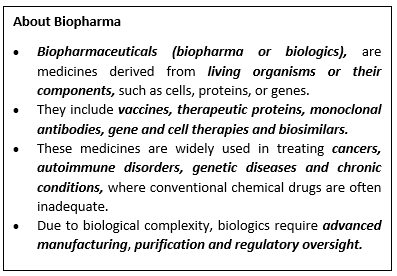
- The scheme was announced against the backdrop of India’s rising burden of non-communicable diseases (NCDs) such as cancer, diabetes and autoimmune disorders, for which biologic medicines are critical.
- It seeks to promote domestic manufacturing of biologics and biosimilars and reduce import dependence in high-value medicines.
- The Budget proposed a unified framework integrating biopharma education, research, clinical trials, and regulatory capacity.
- The announcement also responds to global trade uncertainties, including high tariffs on patented pharmaceutical imports, highlighting the need for India to move up the pharmaceutical value chain beyond generics.
About the Biopharma SHAKTI Scheme
- The Biopharma SHAKTI (Strategy for Healthcare Advancement through Knowledge Technology and Innovation) scheme aims to build an end-to-end ecosystem for biologics and biosimilars in India, covering research, manufacturing, trials and regulation.
- The scheme supports domestic development and large-scale manufacturing of biologics and biosimilars.
- Biologics are complex medicines derived from living organisms such as cells bacteria or animals used to treat diseases, while biosimilars are highly similar, near-identical versions of approved biologics that expand access and can reduce treatment costs.
- New and upgraded institutes: The scheme will establish three new National Institutes of Pharmaceutical Education and Research (NIPERs)and upgrade seven existing ones to create a network focused on high-end biopharma research and innovation.
- Clinical trial expansion: A nationwide network of over 1,000 accredited clinical trial siteswill be developed. This will not only expedite clinical research but also position India as a preferred destination for global trials.
- Regulatory strengthening: The Budget proposes bolstering the Central Drugs Standard Control Organisation (CDSCO) with a dedicated scientific review cadre and specialists to enhance approval timelines and bring regulatory standards up to global benchmarks.
- Innovation and talent development: By fostering synergy between industry, academia, and research institutions, the initiative will nurture skilled professionals capable of driving high-impact biotech innovation.
Significance of the Biopharma SHAKTI Scheme
- Responds to India’s Changing Disease Profile: With non-communicable diseases accounting for about 63% of all deaths in India, the scheme builds domestic biologics and biosimilars capacity essential for long-term management of diabetes, cancer and autoimmune disorders.
- Shields India’s Pharma Sector from Global Trade Shocks: In the backdrop of high tariffs on branded and patented drug imports announced by the US in 2025, Biopharma SHAKTI reduces India’s exposure to trade shocks by diversifying exports beyond generics into biologics and biosimilars.
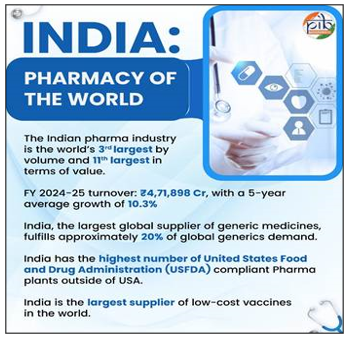
- Enables a Shift from “Pharmacy of the World” to Biopharma Hub: While India currently supplies around 20% of global generic medicine demand, the scheme facilitates a transition towards high-value biologics, helping India move up the pharmaceutical value chain.
- Strengthens Export Competitiveness in Regulated Markets: As over 50% of India’s pharmaceutical exports go to highly regulated markets like the US and Europe, investments in clinical trials and regulatory capacity under the scheme enhance global compliance and export sustainability.
- Protects Long-Term Growth of India’s Pharma Industry: With the pharma sector recording a ₹4.72 lakh crore turnover in FY25 and exports growing at 7% CAGR, Biopharma SHAKTI addresses the structural limits of generic-led growth by anchoring expansion in innovation-driven segments.
- Aligns Health Security with Economic Strategy: By localising production of critical biologic medicines, the scheme simultaneously strengthens health security, reduces import dependence, generates skilled employment, and advances India’s economic and strategic autonomy.
Government Initiatives to Strengthen India’s Biopharma Sector
- The National Biopharma Mission supports innovation in vaccines, therapeutics, diagnostics and medical devices.
- BIRAC provides funding, incubation and mentorship to biotech startups across the country.
- The Production Linked Incentive Scheme promotes domestic pharmaceutical and biopharma manufacturing.
- The Promotion of Research and Innovation in Pharma MedTech scheme supports advanced drug and device research.
- The BioE3 Policy focuses on sustainable biomanufacturing and biotechnology-driven economic growth.
- The Bio RIDE scheme integrates research, innovation, entrepreneurship and biomanufacturing support.