
SYLLABUS
GS-1: Indian culture covers the salient aspects of Art Forms, Literature and Architecture from ancient to modern times.
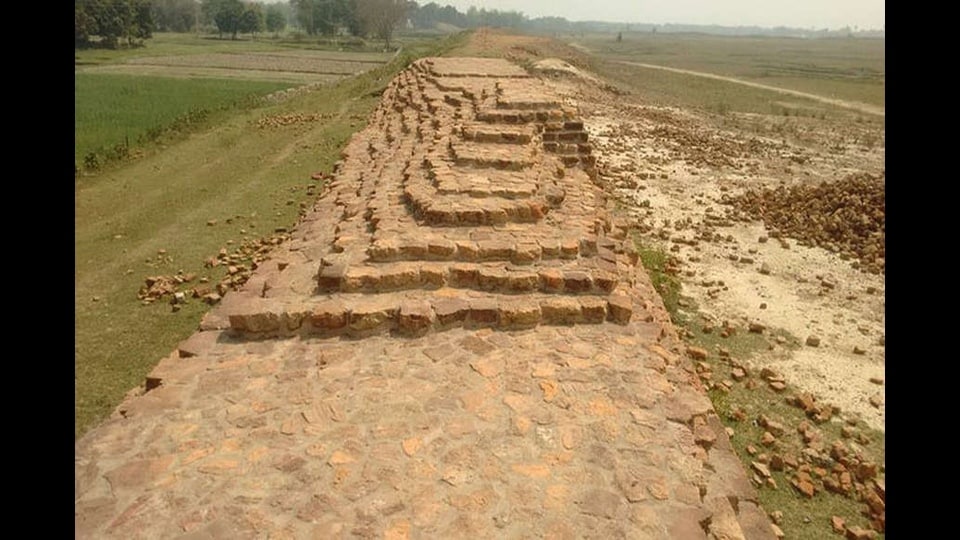
Context: The Archaeological Survey of India has begun a fresh (fifth) round of excavation at Bihar’s Balirajgarh site, believed to be the gateway to ancient Mithila, with the aim of uncovering early urban civilisation and verifying its antiquity.
More on the News
- Balirajgarh has undergone multiple excavations (1962–63, 1972–73, 1974–75, 2013–14), with the latest effort aiming to overcome past constraints such as high-water tables.
- The ASI plans to excavate ~20 trenches using modern tools (satellite mapping, systematic survey) to study five cultural phases: Mauryan (NBPW), Sunga, Kushan, Gupta, and Pala.
- Earlier findings include NBPW pottery, a 10-foot-wide fortification wall (~2200 years old), beads, copper objects, terracotta artefacts, and punch-marked coins, indicating advanced urban planning and continuous habitation from early historic to early medieval periods.
- Preliminary evidence suggests the site may date back to the Iron Age Videha Kingdom, potentially pushing the region’s history back by several centuries.
About Balirajgarh Fort
- Balirajgarh, located in Madhubani district (Bihar), is a massive fortified archaeological site spread over more than 120–176 acres, locally known as Raja Bali Ka Garh.
- It was first identified in 1884 by George Abraham Grierson and declared a protected monument by the ASI in 1938.
- The site is associated with mythological King Bali and is considered by scholars to be a major administrative centre of the Videha Kingdom.
- Archaeological evidence shows a five-fold cultural sequence: NBPW (c. 700–200 BCE) → Sunga → Kushan → Gupta → Pala.
- Indicates continuous habitation from early historic to early medieval period.
- Features such as fortification walls and artefact diversity reflect a well-planned urban settlement.
About Videha Kingdom / Mithila
- Mithila was the ancient capital of the Videha Kingdom, one of the 16 Mahajanapadas during the Later Vedic period (c. 8th–6th century BCE).
- Geographically, it lay in the eastern Gangetic plains, covering present-day north Bihar and parts of Nepal, and is commonly identified with Janakpur.
- The kingdom was later part of the Vajji confederacy (a republican gana-sangha), reflecting early forms of oligarchic governance.
- Mithila is deeply rooted in mythological and cultural traditions, associated with the Janaka dynasty and the Ramayana, where King Janaka (father of Sita) symbolises ideals of dharma and philosophical wisdom.
- It was a major centre of Vedic learning and intellectual activity, linked with figures like Gautama Buddha, Mahavira, and Yajnavalkya.
- The region contributed significantly to scriptural traditions, philosophy, language (Maithili), and art forms like Madhubani painting, maintaining a continuous cultural legacy.
- Politically, Videha was later annexed by Magadha, yet Mithila remained an enduring centre of Sanskritic and philosophical traditions.