
SYLLABUS
GS-2: Government Policies and Interventions for Development in various sectors and Issues arising out of their Design and Implementation.
GS-3: Disaster and Disaster Management.
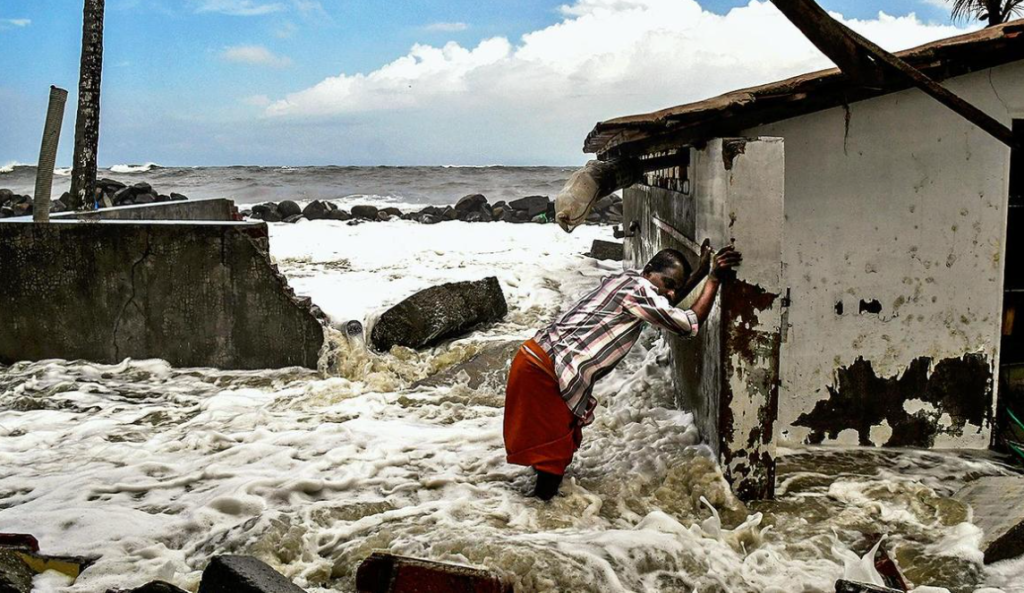
Context: Recently, Kerala became the first State to declare coastal high-tide flooding/sea incursion as a State-specific disaster.
More on the News
• The order, issued under the Disaster Management Act, 2005, clarifies that when tidal flooding causes damage to life, property, livelihoods and infrastructure, it will be treated as a State specific disaster, not a routine tidal event.
- Normally, routine tidal rise does not qualify as a disaster under SDRF norms. However, Section 2(d) of the Disaster Management Act, 2005 defines a disaster as a catastrophe or natural occurrence causing substantial loss of life, livelihood, or property beyond the coping capacity of the community.
• The decision enables the State to use State Disaster Response Fund (SDRF) resources to provide relief to coastal communities affected by sea water intruding beyond the High Tide Line (HTL).
- Under SDRF guidelines, States may use up to 10% of their annual SDRF allocation for “local/State-specific disasters” not included in the nationally notified list of the Ministry of Home Affairs (MHA), subject to approval by the State Executive Committee (SEC).
About Tides and Tidal Lines
• Tides are the periodic rise and fall of sea level driven mainly by the gravitational pull of the moon and sun.
• During full and new moons, the alignment of sun–earth–moon produces spring tides, when tidal ranges are at their maximum and high tides are highest.
• Tidal flooding occurs when sea levels temporarily rise above a threshold and inundate low-lying coastal areas.
• Unlike cyclone storm surges, tidal flooding can occur daily (twice a day) and is more severe during full and new moons (spring tides).
• Under India’s Coastal Regulation Zone (CRZ) framework, coastal management and development controls are anchored to the High Tide Line (HTL) and Low Tide Line (LTL).
- HTL is legally defined as the line on the land up to which the highest water line reaches during the spring tide.
- LTL is the line on the land/shore up to which the lowest water line reaches during spring tides.
About Tidal Flooding in Kerala
• Kerala has a coastline of nearly 590 km, with 9 of its 14 districts along the Arabian Sea, making it uniquely vulnerable to tidal impacts.
• The risk of tidal flooding is most acute in low‑lying areas like Kuttanad (Alappuzha) and the Kochi region, where parts lie at or below sea level.
• Officials estimate that around 10% of Kerala’s population is affected by such coastal flooding, with impacts on fisherfolk, coastal farmers, small traders and residents in fragile coastal belts.
• Contributing factors include deficient land‑use planning (settlements in floodplains, river margins, poramboke lands), siltation/reduced depth of rivers and lakes, and changing coastal geomorphology and sea-level rise.
• Unlike rainfall-induced floods, tidal flooding is a year-round hazard, increasing its cumulative socio-economic impact.
Significance of the Declaration
• Operationalising Timely Relief: The notification enables structured financial assistance under the SDRF framework, ensuring compensation for house damage, livelihood losses, and infrastructure impacts caused by coastal high-tide flooding.
• Strengthening Decentralised Disaster Governance: Kerala’s use of the “State-specific disaster” window demonstrates how states can address context-specific hazards within the Disaster Management Act framework, enhancing flexibility in risk management.
• Mainstreaming Coastal Adaptation Planning: By linking relief eligibility to scientifically defined parameters such as the High Tide Line (HTL), the move supports better land-use regulation, coastal zone planning, ecosystem restoration, and long-term resilience strategies.
• Setting a Policy Precedent: The declaration provides a governance model for other coastal states confronting similar tidal and sea-incursion risks, potentially reshaping how India classifies and manages slow-onset, climate-driven hazards.