
SYLLABUS
GS-3: Awareness in the Fields of IT, Space; Indigenisation of Technology and Developing New Technology.
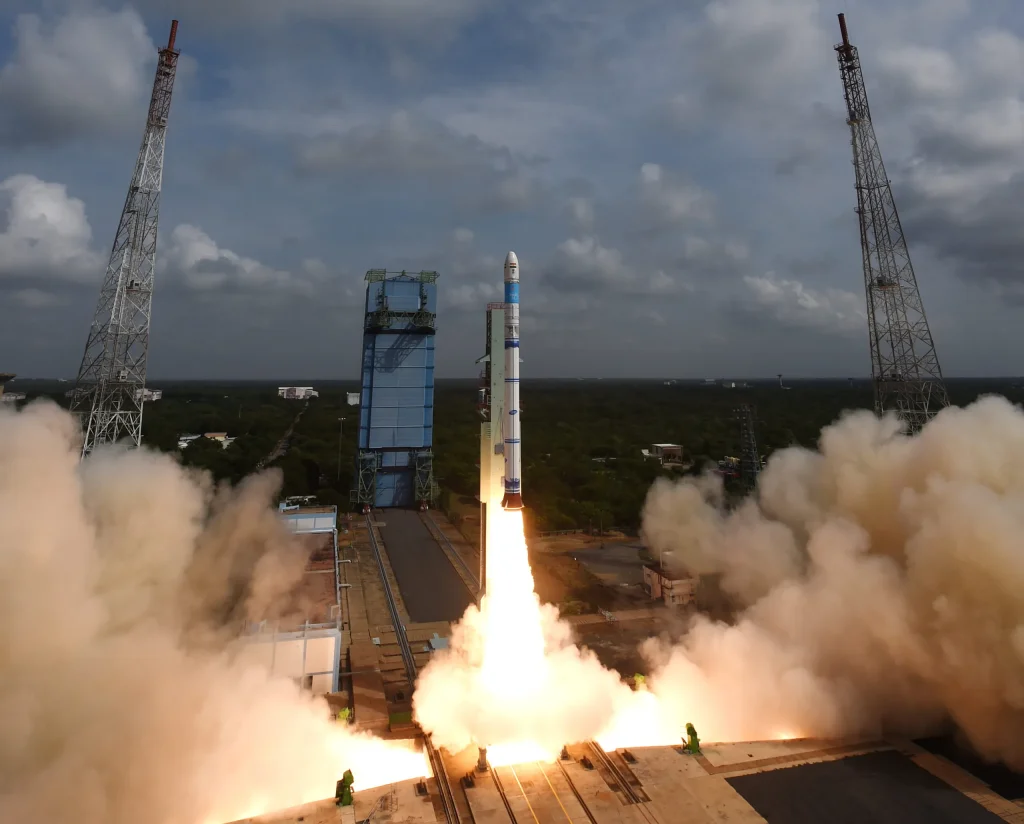
Context: ISRO is targeting December 2026 for the first operational launch of the Small Satellite Launch Vehicle (SSLV), following three development flights, of which the latter two were successful.
About SSLV
- Configuration: Three solid-propulsion stages (SS1, SS2 and SS3), followed by a liquid-propulsion-based Velocity Trimming Module (VTM).
- Payload Capability: Single/Multi Satellites – Nano, Micro and Mini satellites.
- Up to 500 kg to a 500-km planar orbit; can also carry three satellites weighing 10–300 kg into a 500-km planar orbit.
- Key Features: Low cost, quick turnaround, launch-on-demand, multiple-satellite accommodation and minimal launch infrastructure.
- Development Flights: SSLV-D1 (2022) failed; SSLV-D2 (2023) and SSLV-D3 (2024) were successful, completing development flights.
- Comparison of ISRO Launch Vehicles:
- SSLV – Up to 500 kg to 500-km planar orbit; small satellites
- PSLV – Up to 1,750 kg to 600-km Sun-Synchronous Polar Orbit (SSPO)
- GSLV Mk-II – 2-tonne class communication satellites
- LVM3 – 4-tonne class to GTO; 10-tonne class to LEO
Need and Significance of SSLV
- Growing Demand: Caters to increasing demand for small satellites for communication, Earth observation and scientific applications.
- Dedicated Launches: Enables dedicated launches for small-satellite operators instead of relying on rideshare missions aboard larger launch vehicles.
- Responsive Access: Quick turnaround and launch-on-demand capability provide greater flexibility in launch scheduling.
- Cost Efficiency: Offers economical access to space with relatively limited launch infrastructure.
- Commercial Potential: Strengthens India’s competitiveness in the global small-satellite launch market.
Commercialisation and Private Sector Participation
- Technology Transfer: Agreement signed on 10 September 2025 among ISRO, NSIL, IN-SPACe and HAL for transfer of SSLV technology to HAL.
- Industrial Production: SSLV is designed to be production-friendly, enabling Indian industry to manufacture the vehicle and provide commercial launch services.
- Significance: Supports industry-led production, private-sector participation and India’s ability to cater to domestic and international small-satellite launch demand.
India’s Launch Infrastructure
- Satish Dhawan Space Centre (SDSC-SHAR): India’s principal spaceport at Sriharikota, Andhra Pradesh; the First Launch Pad caters to PSLV and SSLV launches.
- Kulasekarapattinam Launch Complex: Upcoming SSLV launch facility in Tamil Nadu, primarily intended for launches to Sun-synchronous polar orbits.
- Timeline: The complex is expected to be commissioned during FY 2026–27, with SSLV launches from the site expected during FY 2027–28.