SYLLABUS
GS-2: Welfare schemes for vulnerable sections of the population by the Centre and States.
Context: The National Overseas Scholarship (NOS) Scheme of the Ministry of Tribal Affairs provides financial assistance to meritorious Scheduled Tribe (ST) students to pursue higher education abroad, promoting inclusive access to global educational opportunities.
More on the News
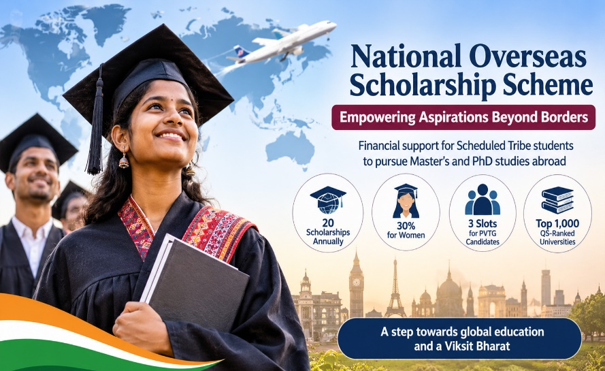
- From 2026-27, the scheme supports Master’s and PhD studies at foreign universities ranked among the top 1,000 in the latest QS World University Rankings.
- It offers 20 fresh scholarships annually, with 30% earmarked for women and three slots reserved for Particularly Vulnerable Tribal Groups (PVTGs).
- Government disbursements increased from ₹0.39 crore in 2015-16 to ₹8 crore in 2025-26.
About the National Overseas Scholarship Scheme
- Ministry: Ministry of Tribal Affairs.
- Nature: Central Sector Scheme, operational since 1954-55.
- Objective: To facilitate higher education abroad for meritorious ST students by reducing financial barriers.
- Implementation: Through Indian Embassies/Missions abroad under the Ministry of External Affairs.
- The scheme expanded from 15 scholarships covering engineering, technology and science in 2010-11 to 20 scholarships across four broad fields.
Key Features of the National Overseas Scholarship Scheme

- Number and Subject-wise Allocation: The scheme provides 20 fresh scholarships annually: 17 for ST candidates and three for PVTG candidates.
- Women’s Participation: 30% of scholarships are earmarked for women. Their share among selected candidates increased from 20% (3 out of 15) in 2015-16 to 47.8% (11 out of 23) in 2024-25. Unfilled women’s slots are opened to eligible male candidates.
- Eligibility Criteria
- Qualification: Minimum 55% marks or equivalent grade in a relevant Bachelor’s degree for Master’s applicants and Master’s degree for PhD applicants.
- Maximum Age: 32 years for Master’s and 35 years for PhD, as on 1 July of the selection year.
- Family Income: Annual income from all sources must not exceed ₹6 lakh.
- Only one child per family is eligible. Each candidate can avail the scholarship once and cannot receive another award at the same or higher level.
- Duration and Financial Assistance: Assistance is available for up to four years for PhD and one or two years for Master’s courses.
- Financial Progress: A total of 400 students received support over the reported period, with 64 new and continuing beneficiaries in 2025-26. Since 2014-15, ₹46.46 crore has been released under the scheme.
Need and Significance of the Scheme
- Promoting Educational Inclusion: Reduces financial barriers and expands access to reputed international universities, complementing the rise in ST higher education enrolment from 21,56,109 (2019-20) to 28,83,218 (2023-24), as per AISHE.
- Empowering Tribal Women and PVTGs: Promotes equitable opportunities through 30% reservation for women and three dedicated scholarships for PVTG candidates; women’s representation among selected beneficiaries rose from 20% in 2015-16 to 47.8% in 2024-25.
- Advancing Knowledge and Research: Provides international exposure, specialised knowledge and advanced research opportunities, strengthening the academic and technical capabilities of tribal students.
- Promoting Socio-economic Mobility: Enhances professional skills, employment opportunities and socio-economic development, while enabling tribal students to contribute to their communities.
- Inclusive Human Resource Development: Strengthens tribal participation in India’s knowledge economy; the scheme supported 64 new and continuing beneficiaries in 2025-26, with 400 students supported over the reported period, contributing to the vision of Viksit Bharat.