

SYLLABUS
Paper I Prelims: Current events of national and international importance.
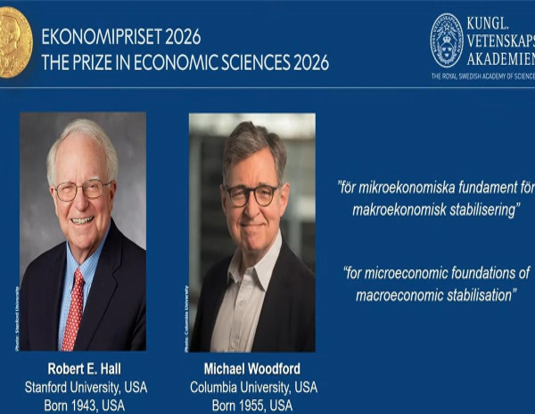
Context: The 2026 Sveriges Riksbank Prize in Economic Sciences in Memory of Alfred Nobel was awarded to Robert E. Hall of Stanford University and Michael Woodford of Columbia University for their contributions to the “microeconomic foundations of macroeconomic stabilisation”.
Key Contributions of Nobel Laureates 2026
- Background: Need for a New Economic Framework
- Limitations of Earlier Models: Traditional Keynesian models relied heavily on historical relationships between macroeconomic variables to predict how the economy would respond to policy changes.
- Oil Crises of the 1970s: Rising oil prices were accompanied by high inflation, high unemployment and low economic growth, challenging conventional economic models.
- Microeconomic Foundations: Economists increasingly focused on how individual households and businesses make decisions and form expectations, recognising that these decisions collectively shape the wider economy.
- Robert E. Hall: Understanding Household Consumption
- Consumption Decisions: In his landmark 1978 paper, Hall showed that consumption follows a pattern in which changes depend significantly on new information about future income, rather than being fully predictable from existing information.
- Permanent Income Expectations: Household spending depends not only on current income but also on expectations about future earnings, savings and access to borrowing.
- Supporting Evidence: Later research by Hall and Frederic Mishkin found that roughly 80% of the households studied broadly followed this consumption pattern.
- Policy Significance: His research helped explain why households respond differently to economic changes and government policies, particularly when their financial circumstances and borrowing constraints differ.
- Michael Woodford: Linking Microeconomic Decisions with Macroeconomic Stability
- Integrated Macroeconomic Models: In his 2003 book, Interest and Prices: Foundations of a Theory of Monetary Policy, Woodford developed a framework linking household consumption, business pricing decisions and central bank interest-rate policies.
- New Keynesian Models: His work strengthened macroeconomic models based on the decisions and expectations of households and businesses, providing a systematic framework for analysing inflation, production, employment and monetary policy.
- Price Stickiness: Prices may adjust slowly to changes in demand or production costs. Consequently, changes in demand can affect output and employment before prices fully adjust.
- Forward Guidance: Central banks can influence present economic decisions by communicating their expected future monetary policy, particularly when immediate interest-rate cuts are limited.
- Output Gap: The difference between actual and potential output indicates economic slack or demand pressure and helps policymakers assess the appropriate stabilisation response.
About the Nobel Prize in Economic Sciences
- Official Name: Sveriges Riksbank Prize in Economic Sciences in Memory of Alfred Nobel.
- Established: 1968 by Sweden’s central bank, Sveriges Riksbank, through a donation to the Nobel Foundation.
- First Awarded: 1969 to Ragnar Frisch and Jan Tinbergen.
- Awarding Institution: Royal Swedish Academy of Sciences.
- Prize Money: 12 million Swedish kronor, approximately US$1.2 million, for the 2026 award.
- Award Ceremony: December 10, 2026, in Stockholm, Sweden.
- Distinction: It was not among the five original Nobel Prizes established under Alfred Nobel’s 1895 will.
- It was created separately by Sweden’s central bank and is awarded according to principles similar to those governing the original Nobel Prizes.