

Assam’s Nameri Tiger Reserve Gets Global Recognition for Conservation Practices
Context: Recently, Nameri Tiger Reserve in Assam received the Conservation Assured | Tiger Standards (CA|TS) Approved status for meeting prescribed standards of tiger conservation and protected-area management.
More on the News
- All four tiger reserves in Assam—Kaziranga, Manas, Orang and Nameri—now have CA|TS Approved status.
- India’s CA|TS status: After the latest addition, India now has 26 CA|TS Approved sites out of 34 globally. The other sites are 4 in Bhutan, 2 in Russia and 1 each in Nepal and Malaysia.
About Conservation Assured | Tiger Standards (CA|TS)
- Nature: CA|TS is a voluntary, independent global framework that assesses whether tiger conservation areas meet minimum standards for effective management and tiger protection. It is not a ranking system.
- Origin: Launched at the First Asian Parks Congress in Japan in 2013, it aims to improve management effectiveness and promote best practices in tiger conservation areas.
- Framework: It comprises 7 pillars and 17 elements, supported by standards and assessment criteria. The pillars cover:
- Importance and status
- Management
- Community
- Tourism (optional)
- Protection
- Habitat management
- Tiger populations
- Assessment and status: The process involves self-assessment, national-level audit and review by the international executive committee. Sites are classified as Registered (standards not yet attained) or Approved (standards verified through assessment and independent review).
124th Birth Anniversary of Loknayak Jayaprakash Narayan
Context: The Prime Minister paid tribute to Loknayak Jayaprakash Narayan on his 124th birth anniversary on 11 October 2026, recalling his fearless opposition to the Emergency and his commitment to good governance and the welfare of marginalised sections.
About Jayaprakash Narayan
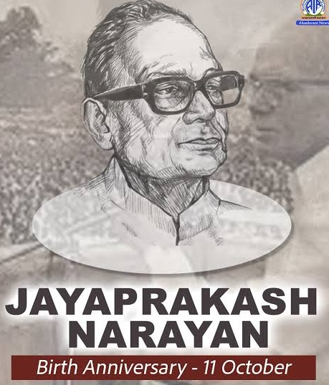
- Early life: Born on 11 October 1902 at Sitabdiara (Jayaprakash Nagar), a village on the Bihar–Uttar Pradesh border, he is popularly known as Loknayak (People’s Leader).
- Role in the freedom struggle: He joined the Indian National Congress in 1929, participated in the Civil Disobedience Movement and played a prominent role in the underground resistance during the Quit India Movement (1942). He escaped from Hazaribagh Central Jail on 9 November 1942.
- Socialist politics: He helped establish the Congress Socialist Party (CSP) in 1934. After Independence, he moved away from electoral politics and became associated with Acharya Vinoba Bhave’s Bhoodan and Sarvodaya movements, which promoted voluntary land donation and social welfare.
JP Movement and Total Revolution (Sampoorna Kranti)
- Background: In 1974, students in Bihar mobilised against issues including corruption, rising prices and unemployment and invited JP to guide their movement. He agreed on the condition that it remain non-violent.
- Call for Total Revolution: On 5 June 1974 at Gandhi Maidan, Patna, JP called for comprehensive transformation of Indian society through non-violent means, extending beyond a change of government.
- Seven components: His vision encompassed social, economic, political, cultural, educational, ideological/intellectual and spiritual transformation, with moral regeneration and decentralisation of power at its core.
- Historical significance: The movement became a major source of opposition to the Emergency (1975–1977). Following the 1977 general election, the Janata Party formed the first non-Congress government at the Centre.
Ideological Legacy and Recognition
- Ideological evolution: JP’s early socialist and Marxist influences evolved towards Gandhian principles of non-violence, decentralisation, voluntary action and moral regeneration.
- Recognition: He was posthumously awarded the Bharat Ratna in 1999 and died on 8 October 1979.
Birth Anniversary of Nanaji Deshmukh
Context: The Prime Minister paid homage to Nanaji Deshmukh on his birth anniversary on 11 October 2026, recalling his contribution to grassroots transformation, rural development, community participation and a self-reliant India.
About Nanaji Deshmukh
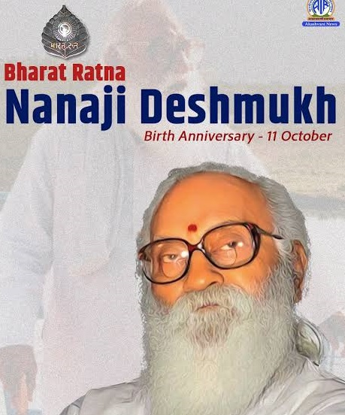
- Early life: Born on 11 October 1916 at Kadoli, Maharashtra, Nanaji was inspired by Lokmanya Tilak’s nationalist ideas and became associated with the Rashtriya Swayamsevak Sangh (RSS).
- Political career: He played an important role in strengthening the Bharatiya Jana Sangh in Uttar Pradesh and supported Jayaprakash Narayan’s Total Revolution movement.
- Elected to the Lok Sabha from Balrampur, Uttar Pradesh, in 1977, he declined a ministerial position and subsequently devoted himself to social work.
- Rural development and education: He founded the Deendayal Research Institute (DRI) in 1968, promoting integrated rural development through community participation and self-reliance. His work in Gonda, Beed and Chitrakoot focused on agriculture, healthcare, education, sanitation and livelihood generation.
- He also established Chitrakoot Gramodaya Vishwavidyalaya, regarded as India’s first rural university.
- Other contributions: He established the first Saraswati Shishu Mandir at Gorakhpur in 1950 and was nominated to the Rajya Sabha in 1999 in recognition of his contribution to society.
- Awards and recognition: He received the Padma Vibhushan in 1999 and was posthumously awarded the Bharat Ratna in 2019. He passed away on 27 February 2010.