
SYLLABUS
GS-2: Statutory, regulatory and various quasi-judicial bodies; Government policies and interventions for development in various sectors and issues arising out of their design and implementation.
GS-3: Conservation; environmental pollution and degradation.
Context: The Commission for Air Quality Management (CAQM) recently approved a revised Graded Response Action Plan (GRAP), strengthening preventive pollution-control measures across Delhi-NCR ahead of winter.
Understanding the Graded Response Action Plan (GRAP)
- About GRAP
- GRAP is an emergency response mechanism to prevent further deterioration of air quality across the National Capital Region (NCR) through progressively stricter pollution-control measures.
- Evolution: Approved by the Supreme Court in 2016, it was first notified by the Ministry of Environment, Forest and Climate Change (MoEFCC) in January 2017, based on recommendations of the Central Pollution Control Board (CPCB).
- Implementation: Initially implemented by the Environment Pollution (Prevention and Control) Authority (EPCA), GRAP is now overseen by CAQM, a statutory body established under the CAQM Act, 2021.
- How Does GRAP Work?
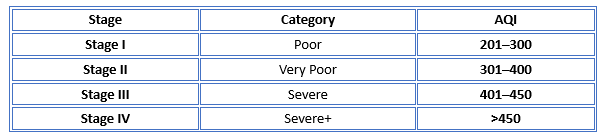
- GRAP operates through four stages, determined by Delhi’s average Air Quality Index (AQI), with forecasts of air quality and meteorological conditions also informing its invocation.
- It is cumulative in nature: measures under earlier stages continue when a higher stage is invoked.
- Institutional Framework
- CAQM coordinates GRAP implementation through the CPCB, State Pollution Control Boards, Delhi Pollution Control Committee, State governments, municipal bodies and other enforcement agencies.
- Its regional approach is important because Delhi-NCR pollution arises from multiple sources, including vehicles, construction dust, industries, waste and biomass burning, compounded by adverse winter meteorological conditions.
Key Changes in the Revised GRAP Schedule
- Earlier Pollution-Control Measures: Restrictions relating to diesel generator sets and entry of older inter-state buses have been shifted from Stage II to Stage I, enabling action before air quality deteriorates further. Repeated measures concerning dust, waste management and transport have also been consolidated.
- Stricter Vehicular Restrictions: Restrictions on older petrol and diesel four-wheelers have been extended to additional NCR areas.
- Further, exemptions previously available to older goods vehicles carrying essential commodities have been withdrawn under Stages III and IV, tightening entry restrictions during severe pollution episodes.
- Expanded Dust-Control Monitoring: Mandatory web-portal-based registration and monitoring of dust-control measures at eligible construction and demolition sites have been extended beyond municipal limits to cover additional urban, development and industrial areas.
- Revised Action Schedule: The updated GRAP comprises 48 actions distributed across four stages, with an expanded Citizens’ Charter prescribing additional Do’s and Don’ts for residents and stakeholders.
Significance of the Revision
- Earlier Intervention: Moving selected restrictions to lower GRAP stages reflects an effort to control emissions before pollution reaches severe levels.
- Source-Specific Regulation: Greater emphasis on vehicular emissions, generator sets and construction dust allows more targeted action against identifiable pollution sources.
- Regional Approach: Wider application of restrictions across NCR recognises that air pollution transcends administrative boundaries and requires coordinated action.
- Limits of Emergency Measures: Although GRAP addresses acute pollution episodes, sustained improvement requires year-round emission reduction through cleaner transport, industrial regulation, waste management and other structural interventions.
Persistent Challenges in Delhi-NCR Air-Quality Management
- Multi-source Pollution: The interaction of vehicular emissions, industrial activities, construction dust, biomass burning and unfavourable winter conditions complicates pollution-control efforts.
- Enforcement Gaps: Effective implementation depends on continuous monitoring, institutional capacity and compliance across multiple sectors and jurisdictions.
- Inter-state Coordination: Pollution sources extend beyond Delhi’s administrative boundaries, necessitating coordinated regional action among NCR States.
- Seasonal Dependence: Repeated reliance on emergency restrictions cannot adequately address persistent emissions arising from urbanisation, transport demand and industrial activities.
Way Forward
- Year-round Prevention: Strengthen source-level emission reduction and integrate air-quality forecasting into anticipatory pollution-control measures.
- Regional Governance: Improve coordination among CAQM, CPCB, State governments and local authorities through an airshed-based management approach.
- Cleaner Urban Infrastructure: Expand public transport, accelerate cleaner mobility and ensure compliance with construction and road-dust management norms.
- Integrated Source Management: Strengthen industrial emission controls, scientific waste management and crop-residue management alongside GRAP implementation.