SYLLABUS
GS-3: Infrastructure: Energy.
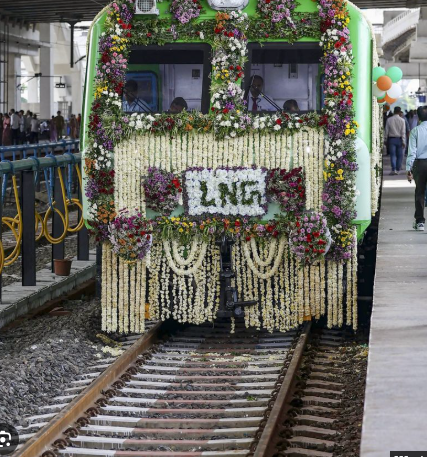
Context: Indian Railways launched India’s first LNG-diesel dual-fuel DEMU train from Sabarmati, Gujarat, adding LNG-based propulsion to its alternative-fuel initiatives.
More on the News
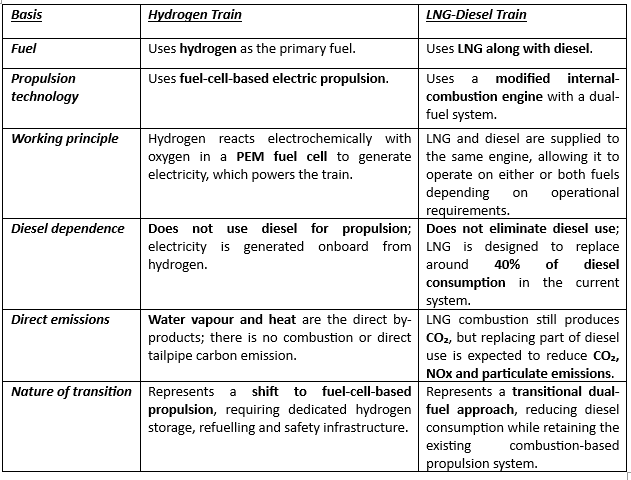
- The train uses a dual-fuel system, allowing the same engine to operate on LNG as well as diesel; LNG is designed to replace around 40% of diesel consumption.
- Two 1,400 HP Driving Power Cars (DPCs) were converted at the Sabarmati Integrated Coaching Depot, and the converted DPCs have completed more than 2,000 km of field trials.
- The initiative aims to reduce diesel consumption, fuel costs and emissions while testing an alternative fuel within the existing railway propulsion system.
About the India’s First LNG-Diesel DEMU Train
- DEMU stands for Diesel Electric Multiple Unit.
- The inaugural rake has 8 non-AC chair-car coaches and operated between Sabarmati and Mahesana Junction.
- Each DPC has an LNG tank of around 2,200 litres, holding approximately 950–1,000 kg of usable LNG.
- A fully loaded LNG tank in one DPC can support around 444 km of operation, according to project estimates.
- The dual-fuel arrangement allows the train to switch between LNG and diesel, providing operational flexibility when LNG availability varies.
- Based on trial data, Indian Railways estimates annual fuel savings of around ₹11.9 lakh per DPC and approximately ₹23.9 lakh for an 8-coach rake.
- LNG substitution is expected to reduce CO₂, NOx and particulate-matter emissions, although LNG combustion still produces CO₂ because it is a hydrocarbon fuel.
Why is India Moving Towards Alternative Fuels?
- Net-zero target: Indian Railways has envisaged becoming a Net Zero Carbon Emitter by 2030.
- Reducing diesel dependence: Electrification has already reduced the use of diesel traction, with 99.2% of the broad-gauge network electrified as of December 2025.
- Greater use of renewable energy: Indian Railways is progressively meeting its traction-power requirements through solar, wind and other renewable sources as part of its net-zero strategy.
- Cleaner propulsion technologies: Hydrogen and LNG-based trains are being explored to reduce dependence on conventional diesel, particularly where alternative propulsion technologies can complement the electrified network.
- Lower emissions: Replacing part of diesel consumption with LNG can reduce CO₂, NOx and particulate emissions, while hydrogen fuel-cell propulsion produces water vapour as the direct by-product.
- Technology diversification: The LNG-diesel train provides a transitional dual-fuel model, while the hydrogen train demonstrates a fuel-cell-based propulsion model, allowing Indian Railways to test different pathways towards cleaner rail transport.
Difference between Hydrogen Train and LNG-Diesel Train