

Project Suncatcher
Context: Google is set to launch a prototype satellite on October 1, 2026, to conduct the first in-orbit test of Project Suncatcher, exploring the feasibility of space-based AI computing infrastructure.
More on the News
- The prototype satellite will carry four Google Tensor Processing Units (TPUs) and fly on SpaceX’s Transporter-18 rideshare mission, in partnership with Planet.
- The mission will test whether AI hardware can withstand launch forces, radiation and extreme temperatures in low Earth orbit (LEO).
- It will also assess cooling technologies using heat pipes and radiators, as conventional air-based cooling is not possible in space.
About Project Suncatcher
- Project Suncatcher is Google’s research initiative, announced in November 2025, to explore whether large-scale AI computing can eventually be conducted in space.
- Its proposed architecture involves satellites equipped with AI processors, solar panels and cooling systems, working together as a distributed computing system.
- Google says solar panels in LEO could potentially generate up to eight times more solar power than comparable panels on Earth because of near-constant sunlight.
- Google has tested its Trillium TPUs against radiation using proton beams at the University of California, Davis, but orbital testing is needed to validate their performance in actual space conditions.
- Future Suncatcher satellites are expected to use high-bandwidth laser links for communication. Google plans to test these links with two satellites in 2027.
Significance of Project Suncatcher
- AI Infrastructure: Could provide an alternative location for expanding energy-intensive AI computing.
- Renewable Energy: Utilises abundant solar energy available in orbit.
- Space Technology: Advances the development of high-performance computing systems capable of operating in harsh space environments.
- Engineering Innovation: Encourages solutions for radiation protection, thermal management and high-speed inter-satellite communication.
- Future Potential: Could reduce dependence on terrestrial power infrastructure if the technical and economic challenges of orbital computing are overcome.
India–GCC Troika Ministerial Meeting
Context: India and the Gulf Cooperation Council (GCC) reviewed their expanding strategic, economic and people-to-people partnership at the India–GCC Troika Ministerial Meeting held in New York on the sidelines of the 81st Session of the United Nations General Assembly.
More on the News
- External Affairs Minister S. Jaishankar co-chaired the meeting, where both sides reviewed progress under the India–GCC Joint Action Plan (JAP) 2024–28 and discussed regional and international issues, including West Asia, commercial shipping, sustainability and terrorism.
- The leaders welcomed the launch of India–GCC Free Trade Agreement (FTA) negotiations after finalising the Terms of Reference in February 2026.
- The partnership is expanding beyond traditional energy ties into trade and investment, food security, health, new technologies, renewable energy, biofuels, green technologies, culture and education.
- India reiterated its commitment to freedom of navigation and safety of seafarers and commercial shipping.
- Both sides also agreed to hold the second India–GCC Joint Ministerial Meeting for Strategic Dialogue at an early date.
About the Gulf Cooperation Council (GCC)
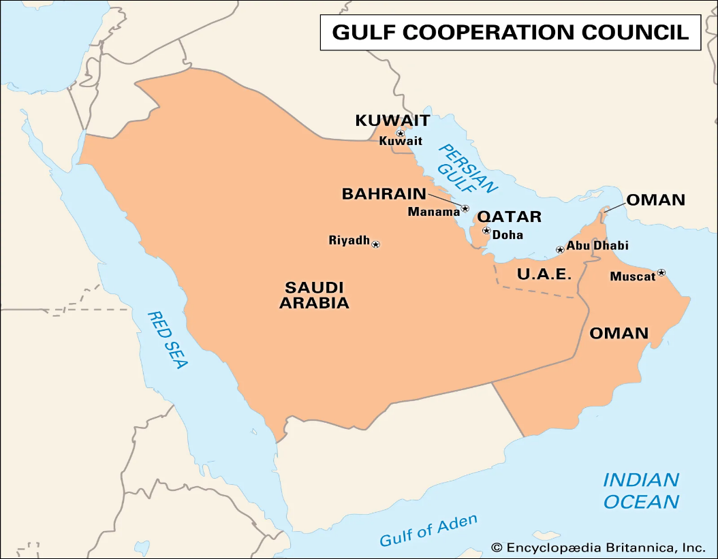
- The GCC, established in 1981, comprises Saudi Arabia, UAE, Kuwait, Qatar, Bahrain and Oman.
- It promotes cooperation among its members in political, economic, security and other areas.
- The Supreme Council is its highest decision-making body, while the Ministerial Council implements its decisions and proposes policies.
India and Gulf Cooperation Council (GCC)
- India’s bilateral trade with the GCC reached USD 178.63 billion in FY 2025–26, accounting for 14.68% of India’s global trade, while cumulative GCC investment in India stood at USD 31.58 billion as of March 2026.
- Institutional engagement began with the first India–GCC Political Dialogue in 2003.
- The first India–GCC Joint Ministerial Meeting for Strategic Dialogue was held in Riyadh in 2024, adopting the JAP 2024–28.
- Around 10 million Indians reside in GCC countries, and remittances from the GCC accounted for nearly 38% of India’s total remittances in FY 2024–25.
World Tourism Day 2026
Context: World Tourism Day 2026 was observed on 27 September in El Salvador under the theme “Digital Agenda and Artificial Intelligence to Redesign Tourism”, highlighting the role of digital technologies and Artificial Intelligence in transforming the tourism sector.
About World Tourism Day
- World Tourism Day is observed annually on 27 September by the United Nations World Tourism Organization (UN Tourism).
- The day commemorates the adoption of the organisation’s statutes in 1970 and was first celebrated in 1980.
- It highlights the contribution of tourism to economic growth, employment, cultural exchange and sustainable development, including the achievement of the Sustainable Development Goals (SDGs).
- The 2026 theme focuses on how digital technologies and Artificial Intelligence can make tourism more accessible, personalised, efficient, inclusive and sustainable.
Significance of World Tourism Day
- Economic contribution: Tourism contributed 5.22% to India’s GDP and supported 8.46 crore jobs in 2023–24.
- Growing tourist movement: India recorded 428.55 crore domestic tourist visits and 2.53 crore foreign tourist visits in 2025.
- Foreign exchange: Foreign exchange earnings from tourism reached ₹2,76,831 crore in 2025.
- Digital transformation: Platforms such as e-Visa, Incredible India Digital Platform and NIDHI+ are simplifying travel and integrating tourism services.
- Sustainable tourism: Initiatives such as Swadesh Darshan 2.0, PRASHAD and Challenge-Based Destination Development promote destination development, better visitor facilities and local livelihoods.
- AI-enabled tourism: Artificial Intelligence can support personalised travel planning, destination management, digital promotion and improved visitor experiences.
Exercise Tarang Shakti 2026
Context: The Indian Air Force (IAF) commenced the operational phase of Exercise Tarang Shakti 2026 at Air Force Station Jodhpur, with the multilateral air exercise being conducted from 26 September to 12 October 2026.
About the Tarang Shakti 2026
- Theme: “Power in Partnership”, highlighting cooperation, mutual learning and interoperability among partner air forces.
- Participants: Seven Friendly Foreign Countries (FFCs)—Australia, the USA, UAE, France, Germany, Sri Lanka and Bangladesh—are participating with air assets, while several other countries are attending as observers.
- Aircraft: Participating foreign aircraft include F-35 Lightning II, Rafale, F-16, A400M, MRTT, C-130, C-130J and KC-30A, representing combat, airlift and air-to-air refuelling capabilities.
- Objectives: To facilitate advanced joint training, multinational mission planning, operational experience-sharing and interoperability in contemporary air operations.
- Operations: The exercise covers complex missions including counter-air, air defence, force combat, reconnaissance, airlift and air-to-air refuelling.
- Significance: It strengthens professional interaction among aircrew, mission planners and support personnel while promoting mutual trust, aerospace safety and understanding of operational procedures and capabilities.