
SYLLABUS
GS-3: Infrastructure: Energy and Achievements of Indians in science & technology; indigenization of technology and developing new technology.
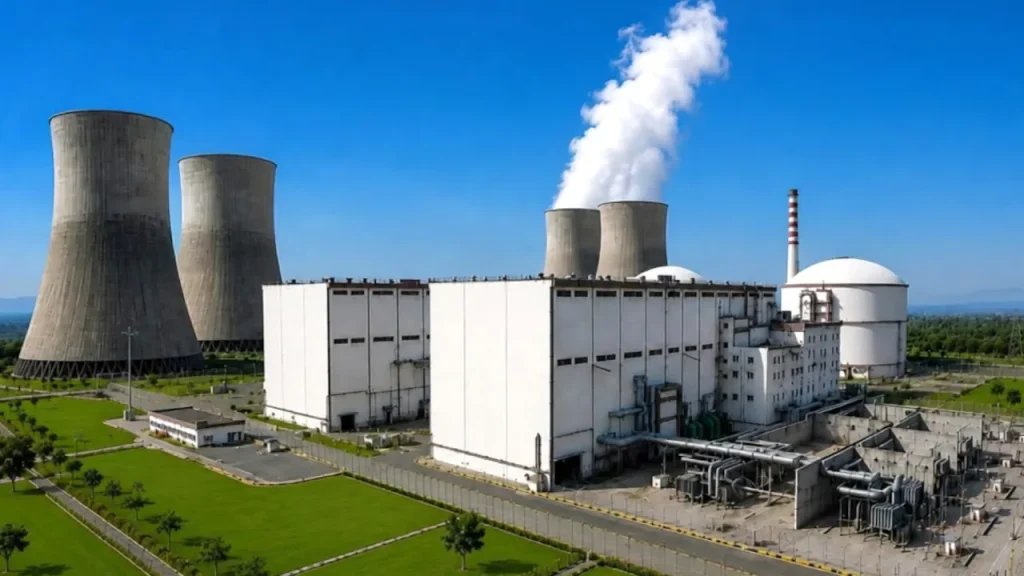
Context: The Nuclear Power Corporation of India Limited (NPCIL) recently commenced Initial Fuel Loading (IFL) at RAPP-8, a 700 MWe indigenous Pressurised Heavy Water Reactor (PHWR) at Rawatbhata, Rajasthan, marking a key step towards its commissioning.
More on the News
- RAPP-8 is the fourth reactor in the series of 16 indigenous 700 MWe PHWRs being deployed in fleet mode.
- The first two reactors in this series — Units 3 and 4 at Kakrapar Atomic Power Station (KAPS) in Gujarat — commenced commercial operation in 2023-24, followed by Unit 7 of RAPP in April 2025.
- Apart from Unit 8 of RAPP, NPCIL currently has eight other reactors under construction — two each at Gorakhpur in Haryana and Kaiga in Karnataka, and four at Kudankulam in Tamil Nadu.
Understanding India’s Three-Stage Nuclear Power Programme
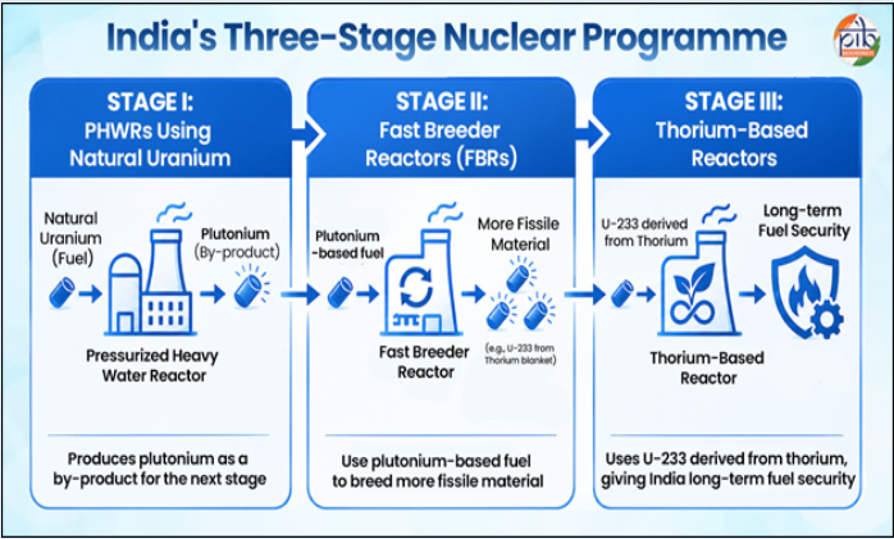
- Rationale: Conceived by Dr Homi J. Bhabha in the 1950s, the programme follows a closed nuclear fuel cycle to optimise India’s limited uranium resources and progressively utilise its abundant thorium resources.
- Stage I – PHWRs: PHWRs use natural uranium and heavy water as moderator and coolant. They generate electricity while producing Plutonium-239 (Pu-239) from U-238, which becomes the fuel base for the next stage.
- Stage II – FBRs: Fast Breeder Reactors use plutonium-based fuel and breed additional fissile material by converting U-238 into Pu-239. They can subsequently facilitate the conversion of thorium into Uranium-233 (U-233).
- Stage III – Thorium: Thorium-232 is fertile, not fissile; it can absorb neutrons and transform into fissile U-233, enabling eventual large-scale thorium utilisation.
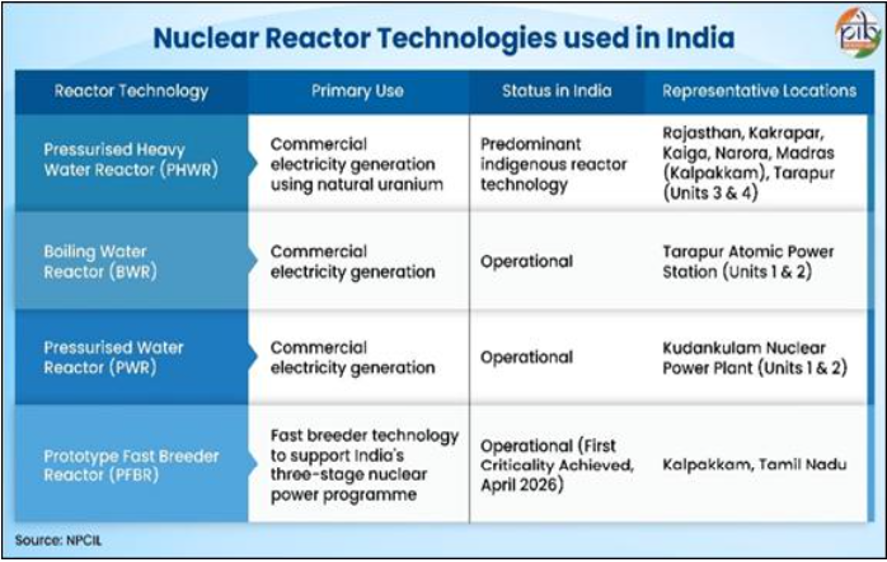
- PFBR milestone: The 500 MWe Prototype Fast Breeder Reactor (PFBR) at Kalpakkam attained first criticality on 6 April 2026, marking India’s entry into Stage II.
India’s Nuclear Energy Landscape
- Present status: India operates 24 nuclear power reactors across seven sites, with an installed capacity of 8.78 GW. Nuclear power accounted for 3.1% of India’s total electricity generation in 2024–25.
- Reactor profile: The operational fleet comprises 20 PHWRs, two BWRs at Tarapur and two VVER reactors at Kudankulam, reflecting India’s indigenous PHWR base alongside imported reactor technologies.
- Current expansion: Nine reactor units with a combined capacity of 7.5 GW are under construction, while 10 indigenous PHWRs have been approved for fleet-mode construction and preparations are underway for additional units.
- Near-term capacity: India’s nuclear capacity is projected to reach 22.38 GW by 2031–32, primarily through progressive completion of projects at various stages of implementation.
- Long-term target: The Nuclear Energy Mission for Viksit Bharat aims to achieve 100 GW of nuclear capacity by 2047, positioning nuclear power as a reliable, low-carbon source of baseload electricity.
- Technology diversification: The expansion includes indigenous 700 MWe PHWRs, large LWRs through international cooperation, FBRs and SMRs, with pre-project activities approved for two 500 MWe FBRs.
Recent Initiatives for Expansion of Nuclear Energy Sector
- SHANTI Act, 2025: The Act enables private-sector participation in nuclear facilities and activities under Central Government licensing and regulatory safety authorisation, while giving statutory status to the Atomic Energy Regulatory Board (AERB).
- Draft SHANTI Rules, 2026: The proposed rules provide the operational framework for licensing, nuclear liability, financial security and safety, including a composite licence for construction, ownership, operation and decommissioning.
- SMR Mission: The Nuclear Energy Mission provides ₹20,000 crore for indigenous SMR development, with a target of at least five indigenous SMRs by 2033. BARC is developing the BSMR-200, SMR-55 and a high-temperature gas-cooled reactor for hydrogen production.
- Fuel-security partnerships: India has signed civil nuclear cooperation agreements with 18 countries.
- In July 2026, India and Australia finalised an Administrative Arrangement enabling long-term Australian uranium exports to India for peaceful purposes under IAEA safeguards, strengthening fuel diversification.
Challenges Ahead
- High capital cost and long gestation: Nuclear projects require substantial upfront investment, complex construction and lengthy commissioning, making timely execution critical.
- Fuel security: Rapid expansion requires assured uranium supplies alongside efficient reprocessing and development of a closed nuclear fuel cycle.
- Safety and regulatory capacity: Greater private participation and deployment of new technologies will increase demands on regulatory expertise, independence and enforcement capacity.
- Waste, liability and public confidence: Safe radioactive-waste management, effective liability mechanisms, emergency preparedness and sustained public confidence remain essential for long-term expansion.
Way Forward
- Accelerate fleet-mode deployment: Scale up standardised 700 MWe PHWRs through efficient project management, bulk procurement and stronger domestic supply chains.
- Advance the three-stage programme: Strengthen FBRs, reprocessing and closed fuel-cycle technologies to build the fissile-material base required for eventual thorium utilisation.
- Ensure safety-led expansion: Strengthen AERB’s technical and institutional capacity while maintaining stringent standards for reactor safety, radioactive-waste management and emergency preparedness.
- Balance indigenisation with international cooperation: Diversify uranium supplies and access advanced technologies through international partnerships while progressively strengthening domestic capabilities across the nuclear fuel cycle.